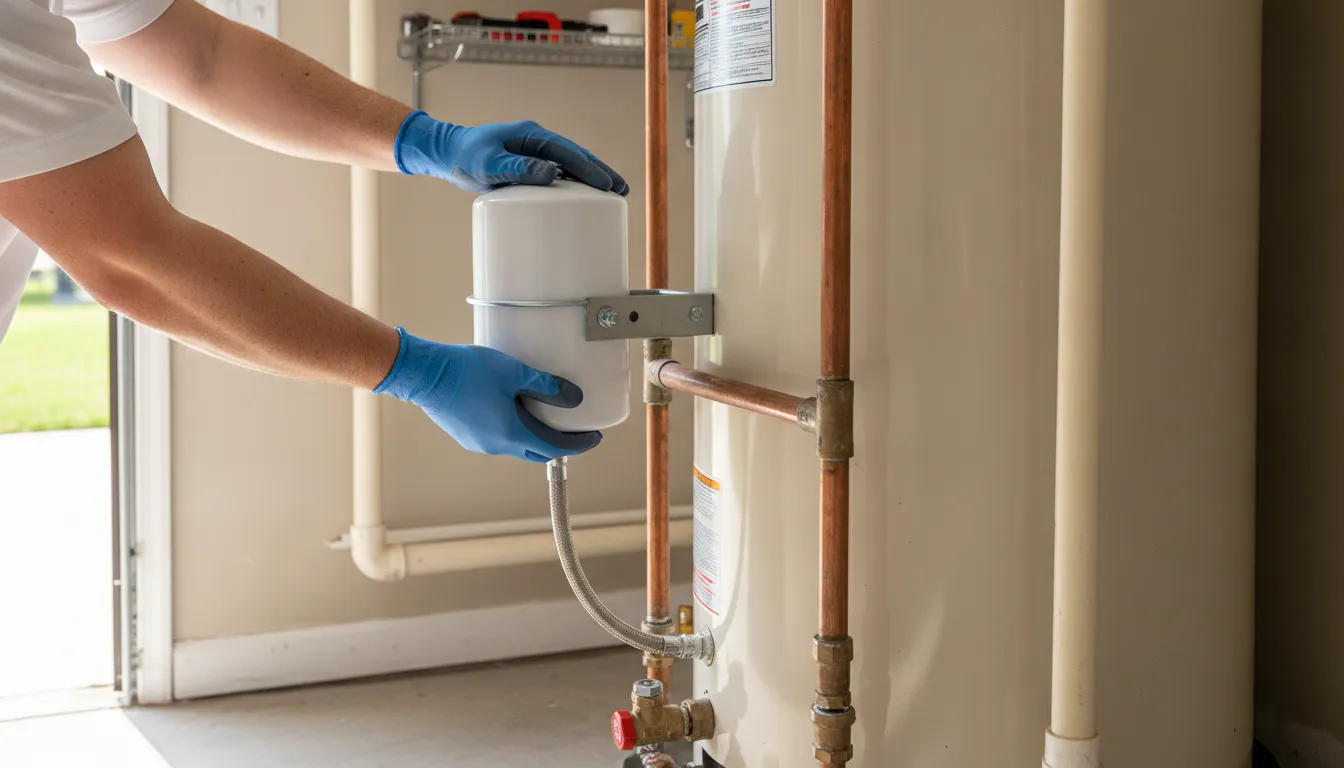
A water heater expansion tank installation keeps a closed plumbing system from turning hot water into extra pressure. When a storage heater warms cold water, that water takes up more space. If a check valve, pressure-reducing valve, or backflow preventer blocks the path back to the street, the extra volume stays in the house. The tank gives it somewhere to go.
Call (941) 921-4846 to schedule a water heater expansion tank installation, or request a free estimate.
On Florida’s Gulf Coast, the answer is not the same for every house from Tampa to Marco Island. An open system can sometimes push the expanded water back toward the utility. A closed system usually cannot. Premier Plumbers checks which one you have before recommending a tank, then quotes the work for that heater and that piping.
When a Gulf Coast Home Needs an Expansion Tank
Whether a storage water heater needs an expansion tank depends in part on how water moves through the home’s supply piping. The key question is whether the plumbing system is open or closed. In an open system, water can move back toward the public supply when heated water expands. That movement may relieve the added pressure, so an expansion tank may not be needed. A plumber still has to confirm the system rather than assume it from the water heater alone.
A closed system has a device that prevents that reverse flow. Common examples include a check valve, pressure-reducing valve, or backflow preventer. When water is heated inside a storage tank, it expands. If those valves stop the expanded water from pushing back toward the street, pressure can rise within the home’s plumbing. In that situation, the 2023 Florida Building Code, Residential, Sections P2903.4 and P2903.4.2, addresses installing a means of controlling increased pressure caused by thermal expansion when the listed conditions apply.
A few details suggest the system is closed. A pressure-reducing valve on the incoming line is one. A backflow preventer at the water service is another. So is a check valve that stops water from flowing back toward the street.
Those clues are a start, not a substitute for tracing the piping. Homes in Sarasota, Fort Myers, Tampa, and nearby Gulf Coast towns do not all share the same water-service setup. A system can also change after the heater was installed. A plumber confirms whether the supply is closed and whether the control matches the heater and the tank maker’s instructions.
The shared model-code idea is simple. When cold water passes through a check valve, pressure-reducing valve, or backflow preventer before it reaches a storage heater, the expansion device connects on the cold inlet downstream of those valves. That spot lets the device see pressure in the isolated section. Explanations of this wording from other states are not Florida law. Florida homes are judged under the Florida Building Code.
As a simple physics note, heating the water in a 50-gallon tank from 40 degrees to 140 degrees can make it expand by about three-quarters of a gallon. That does not diagnose a plumbing problem, and sounds alone do not prove that an expansion tank is needed. If you are trying to understand water heater noises, start with the right inspection of the system instead of guessing from the sound.
What the Tank Does and What Size Fits
An expansion tank is a small tank installed on the cold-water supply serving a storage water heater. Inside, a flexible bladder or diaphragm separates the plumbing water from a pocket of air. As the heater warms the water, the water expands. Instead of forcing that extra volume against a closed plumbing system, the air cushion gives it somewhere to go and helps moderate the pressure.
The tank size is not chosen from the heater’s gallon rating alone. Incoming water pressure matters. So does the thermostat setting, and whether the home is closed. Use the chart for the specific tank you are installing, not a generic gallon guess. The code reason the tank exists at all is in the 2023 Florida Residential Code section on thermal expansion control.
The table below is an example published in Amtrol’s Therm-X-Trol quick sizing brochure MC4090 (September 2025). It shows the model Amtrol lists when incoming water is 40 degrees, the relief valve is rated 150 psi, and the precharge matches static supply pressure. It is one maker’s starting chart, not a Premier Plumbers menu and not a final pick for every house.
| Water heater size. | 40 psi. | 60 psi. | 80 psi. |
|---|---|---|---|
| 40 gallons. | ST-5. | ST-5. | ST-5. |
| 50 gallons. | ST-5. | ST-5. | ST-5. |
| 60 gallons. | ST-12. | ST-12. | ST-12. |
| 80 gallons. | ST-12. | ST-12. | ST-12. |
| 120 gallons. | ST-12. | ST-12. | ST-25V. |
Read the row for the heater size, then the column for the measured static pressure. A 50-gallon heater at 40, 60, or 80 psi is an ST-5 on this 140-degree chart. A 120-gallon heater at 80 psi steps up to an ST-25V. A hotter thermostat changes the chart: the same brochure’s 180-degree table lists an ST-12 for a 40-gallon heater at every one of those pressures. Larger heaters, a different brand, or a pressure outside this grid belong on that maker’s full chart, not on a guess from this sample.
During water heater expansion tank installation, the air charge is set to match static incoming pressure before the tank is filled. Two heaters with the same gallon label can still need different tanks once the pressure is measured.
About 80 psi is the common point where a pressure-reducing valve enters the conversation. That number does not decide every job by itself. Heater size, measured pressure, the valves on the supply, and the piping connection decide whether a tank belongs and how large it should be.
What Water Heater Expansion Tank Installation Looks Like
The visit is a diagnosis first and a fitting second. A Premier Plumbers technician confirms the heater stores water, finds whether the supply is closed, and only then mounts a tank. Do not add one just because a neighbor has one. A well house, a home with a pressure-reducing valve, and a home with a utility backflow device can look alike and still need different answers.
Here is what the installation visit covers:
- Confirm the system is closed by locating any check valve, pressure-reducing valve, or backflow preventer on the supply.
- Read the static water pressure so the tank size and the air charge both match the house.
- Choose the tank from the manufacturer’s chart for that heater volume and that pressure.
- Mount the tank on the cold-water inlet, downstream of those valves, with a tee and a shutoff so it can be replaced later.
- Support the tank. A full expansion tank is heavy, and the nipple on top of the heater is not a shelf.
- Set the air charge to the incoming pressure before the tank takes on water.
- Check that the temperature-and-pressure relief valve is not being asked to dump the expansion. A dripping valve is a warning, not a substitute for a tank.
Scheduling runs through the contact page. The form collects a time that works for you, and the office follows up to set the visit. It is not instant booking, and it is not a promise that a truck arrives inside a measured window. If water is actively leaking, call and ask about emergency plumbing. For a planned tank on a quiet heater, request a free estimate and schedule a regular visit.
Crews work from Sarasota-Bradenton, from Fort Myers (the office that also covers Naples), and from Tampa. The water heater service page lists the repair and replacement work those crews already do. If you sit near the edge of Sarasota, Manatee, Charlotte, Lee, Collier, or Hillsborough County, call before you assume the route includes you.
Signs You Should Call Before the Heater Fails
You do not need a failed heater to justify the call. The clearest sign is a relief valve that weeps while the heater fires, then goes quiet when the burner or elements shut off. That valve is a safety outlet, not a daily pressure vent. Using it that way shortens its life and can leave mineral crust in the discharge line.
A pressure gauge that climbs after showers tells the same story with a number. The needle rises once the tank recovers. It drops after someone runs cold water. The system is absorbing expansion somewhere it was not designed to. A new heater makes this more urgent, not less. Replacing a heater on a closed system without expansion control just moves the stress onto the new tank.
It also matters when a previous plumber said the house might be closed and left the question open. An open system can legitimately skip the tank. Guessing wrong is what leaves the relief valve doing work it was never meant to do every afternoon.
Gulf Coast water carries plenty of dissolved mineral, so scale builds faster here than in a soft-water city. That is a reason to look sooner. It is not proof you need an expansion tank. If the problem is no hot water, start with our guide to a water heater that is not heating. If you are weighing repair against replacement, read the water heater repair guide. Neither page answers the expansion-tank question.
What Installation Costs on the Gulf Coast
Premier Plumbers quotes each water heater expansion tank installation after a technician sees the heater, the pressure, and the piping. There is no printed price menu for this job. The price is set for that visit after the assessment, not from a published rate card.
What changes the quote is the work in front of the technician. A larger heater, higher incoming pressure, a tank that needs extra support, or piping that has to be rearranged takes more time and material. A simple add-on, on a heater that already has a usable cold inlet, is a shorter visit. The tank capacity comes from the manufacturer’s chart for that pressure, so two houses with the same heater can still get different quotes.
Permits are a local question. Some Gulf Coast cities want one when a water heater or its safety devices change. Others treat a small add-on differently. That difference belongs in the quote. The underlying rule is in the 2023 Florida Residential Code section on thermal expansion control. A closed system with a storage heater needs a way to control the extra pressure. Ask for a free estimate. We will price the job in front of us, including any permit the city requires.
After the Tank Is In
A new tank is not a forever part. The air charge can drift, and the bladder can fail. When that happens the tank fills with water and stops absorbing expansion. The relief valve may start dripping again even though the tank is still hanging on the pipe.
Once a year, or when you notice that drip, have the charge checked with the water pressure shut off from the tank. The reading should still match the home’s static pressure. If the tank sounds full of water when you tap it, or if water comes out of the air valve, the bladder is done and the tank should be replaced. Match the new one to the current pressure, not to the old label if a pressure-reducing valve was added later.
Keep the tank supported and leave the shutoff usable. A tank wedged against a wall, or hung only from a nipple, is the one that leaks at the threads years later. Support is not optional on a part that gets heavier once it holds water.
None of this replaces looking at the heater itself. If the burner, the elements, or the tank wall are the real problem, the expansion tank will not fix them. It only handles the extra volume created when the heater does its normal job.
Premier Plumbers can fold a charge check into a regular water heater visit across Sarasota, Fort Myers, Naples, and Tampa. Call the office that covers your address if you are not sure which number to use. Sarasota-Bradenton is (941) 257-9115. Fort Myers and Naples are (239) 427-2175. Tampa is (813) 279-8575. The main line, (941) 921-4846, reaches dispatch for any of those areas.
If the relief valve drips or the pressure gauge climbs, call Premier Plumbers at (941) 921-4846 or request a free estimate. We will confirm whether the home needs a tank and quote that job.
Frequently Asked Questions
Where should an expansion tank go on a water heater?
On the cold-water inlet, downstream of any check valve, pressure-reducing valve, or backflow preventer. That is the isolated side of the system, which is the only place the tank can absorb the extra volume. It also needs support and a shutoff so the weight is not hanging on a pipe nipple.
How is an expansion tank sized?
Sizing uses the water heater’s storage capacity, the thermostat setting, the measured static pressure, and the tank maker’s chart. On Amtrol’s 140-degree example, a 50-gallon heater at 40, 60, or 80 psi is an ST-5. A plumber should not choose a tank from the heater’s gallon label alone.
Is an expansion tank required by code in Florida?
The 2023 Florida Residential Code requires a pressure-control device when a backflow preventer, check valve, or similar device closes a system with a storage water heater. An open system may not trigger that rule. A plumber confirms which system you have instead of adding a tank by default.
How much does water heater expansion tank installation cost?
Premier Plumbers prices the job after seeing it. The quote depends on tank size, incoming pressure, how the piping has to change, and whether the city requires a permit. There is no printed price for this visit.
Do I need a tank if the house is on a well?
Maybe. A well system often already has a pressure tank and a check valve, which can close the plumbing even though there is no city meter. The well’s pressure tank is not the same device as a thermal expansion tank on the water heater. We check both before recommending one.