What to Do When Your Water Heater Is Not Heating
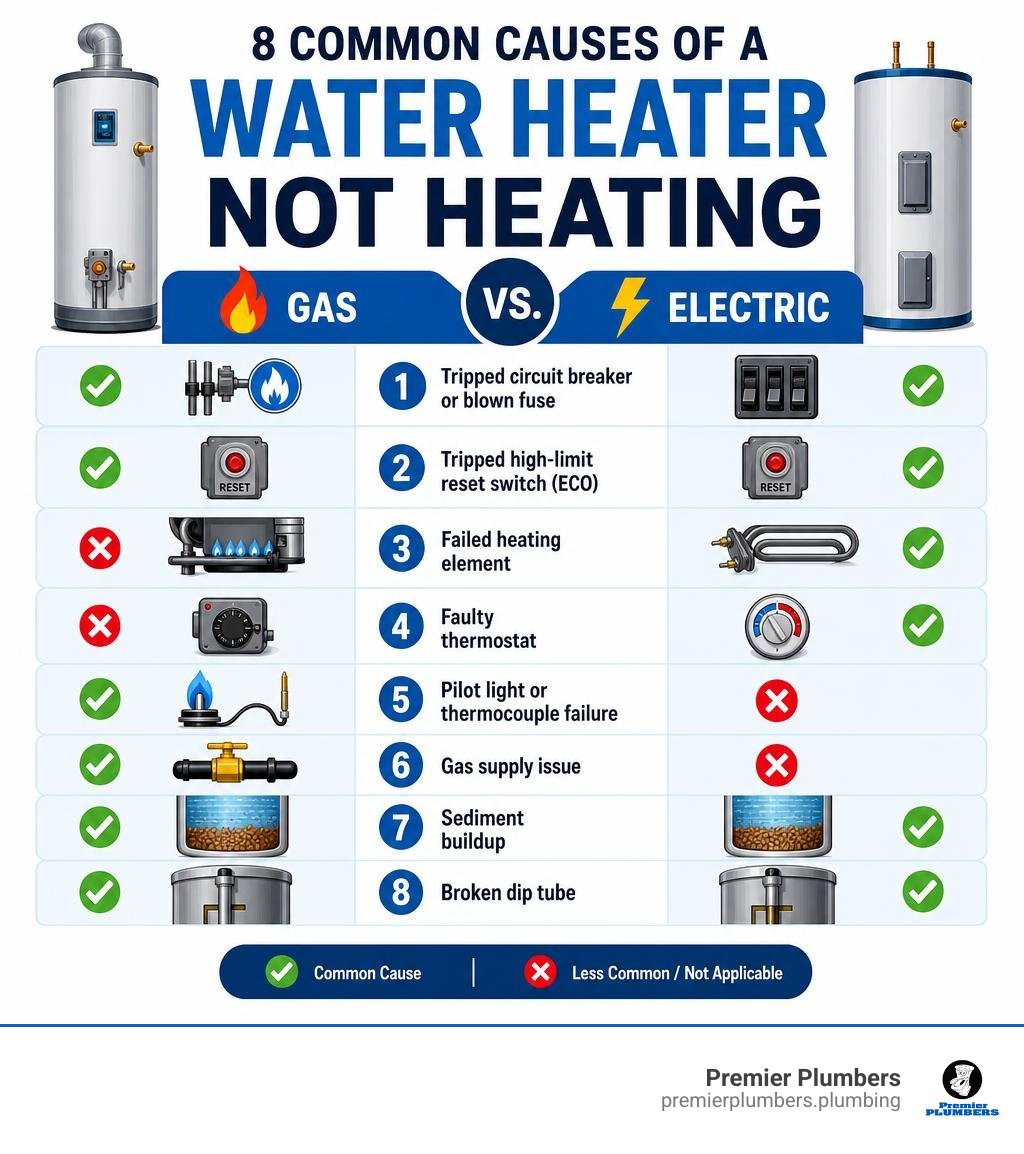
A water heater not heating is one of the most disruptive problems a Florida homeowner can face, and it usually happens at the worst possible time. Here are the most common reasons why, at a glance:
Most common causes of a water heater not heating:
- Tripped circuit breaker or blown fuse – the most frequent cause for electric units
- Tripped high-limit reset switch (ECO) – an often-overlooked safety shutoff inside the unit
- Failed heating element – one or both elements burn out over time
- Faulty thermostat – stops signaling the elements to heat
- Pilot light or thermocouple failure – the primary culprit in gas water heaters
- Gas supply issue – no fuel reaching the burner
- Sediment buildup – acts as a heat barrier inside the tank
- Broken dip tube – cold water mixes with hot, causing lukewarm output
Whether you’re getting completely cold water or just a disappointing lukewarm trickle, the fix depends on identifying the right cause first.
At Premier Plumbers, our team of third-generation plumbers has decades of collective experience diagnosing and fixing every type of water heater not heating problem across Southwest Florida. In this guide, we will walk you through each cause step by step so you know exactly what you’re dealing with.
Why Is My Water Heater Not Heating at All?
When you turn on the hot water tap and receive nothing but an icy blast, you are dealing with a complete system failure. In these situations, the water heater is not receiving power, is unable to ignite its fuel, or has shut itself down for safety reasons.
To diagnose a water heater that has completely stopped heating, we must look at the primary inputs: electricity for electric models, and gas supply for gas models. Before diving into the electrical panel, you should gather a few basic troubleshooting tools. A non-contact voltage tester and a digital multimeter are essential for safely verifying electrical currents.
Tripped Circuit Breaker or Blown Fuse
For electric water heaters, the very first place to look is your home’s main electrical panel. Electric water heaters do not run on standard household outlets. Instead, they require a dedicated double-pole circuit breaker, which is typically rated for 30 amps to handle the heavy electrical load of the heating elements.
Sometimes, a power surge or a temporary overload will cause this breaker to trip. When you inspect your electrical panel, look for a breaker labeled “Water Heater” that has migrated to the middle or “off” position. To reset it, push the switch completely to the “off” position until you hear a click, and then flip it back to “on.”
However, if the breaker trips again immediately, do not attempt to reset it a second time. This is a clear indicator of a serious electrical fault, such as a short circuit or a grounded heating element. In some cases, an older breaker can fail partially: it might show a normal 240-volt reading under no-load conditions but drop voltage significantly or begin buzzing as soon as the water heater draws power.
Tripped High-Limit Reset Switch (ECO)
If your breaker is on but your electric water heater is still completely dead, the culprit is likely the high-limit safety switch, also known as the Energy Cut Off (ECO). This safety device is located behind the upper access panel of your water heater, right above the upper thermostat.
The ECO acts as a fail-safe. If the water temperature inside the tank exceeds a safe threshold, which is typically around 170 degrees Fahrenheit, the ECO automatically cuts off all electrical power to both heating elements to prevent the water from boiling and building up dangerous pressure. This can happen due to a power surge, a malfunctioning thermostat that stays stuck in the “on” position, or heavy mineral scale insulating the elements.
To reset it, you must first turn off the power at the circuit breaker for safety. Remove the upper access panel, pull back the insulation, and locate the small red button. Press it firmly. If you hear a sharp click, the ECO was tripped and has now been reset. You can then restore power. If the ECO continues to trip repeatedly, you may need professional testing or replacement of the thermostat, elements, or related wiring.
For homeowners who want help narrowing down electrical, thermostat, or heating-element issues, Premier Plumbers offers water heater repair and installation services across Sarasota, Bradenton, Fort Myers, Naples, Tampa, Charlotte County, Collier County, and Lee County.
Gas Pilot Light or Thermocouple Failure
If you own a gas water heater, a complete lack of hot water is almost always tied to the pilot light, the thermocouple, or the gas control valve. Gas water heaters rely on a small, continuously burning flame called a pilot light to ignite the main burner when the thermostat calls for heat.
The most common point of failure here is the thermocouple. This is a small copper rod that sits directly in the path of the pilot flame. The thermocouple acts as a safety sensor. When heated by the flame, it generates a tiny electrical current that tells the gas control valve it is safe to keep sending gas. If the pilot light goes out, or if the thermocouple is dirty, bent, or faulty, the gas valve will shut off all gas flow to prevent a dangerous gas leak into your home.
If your pilot light is out, you can attempt to relight it following the manufacturer instructions printed on the side of your tank. If the flame ignites but goes out the moment you release the control knob, your thermocouple is likely worn out or covered in soot. Sometimes, a gentle cleaning with fine-grit sandpaper can restore its connection, but more often than not, a worn thermocouple must be replaced.
Why Is My Water Heater Only Producing Lukewarm Water?
There is nothing quite as frustrating as stepping into the shower expecting a relaxing, hot stream, only to be met with a lukewarm drizzle. When your water heater is producing some heat but not enough, the problem is usually a partial system failure rather than a complete power loss.
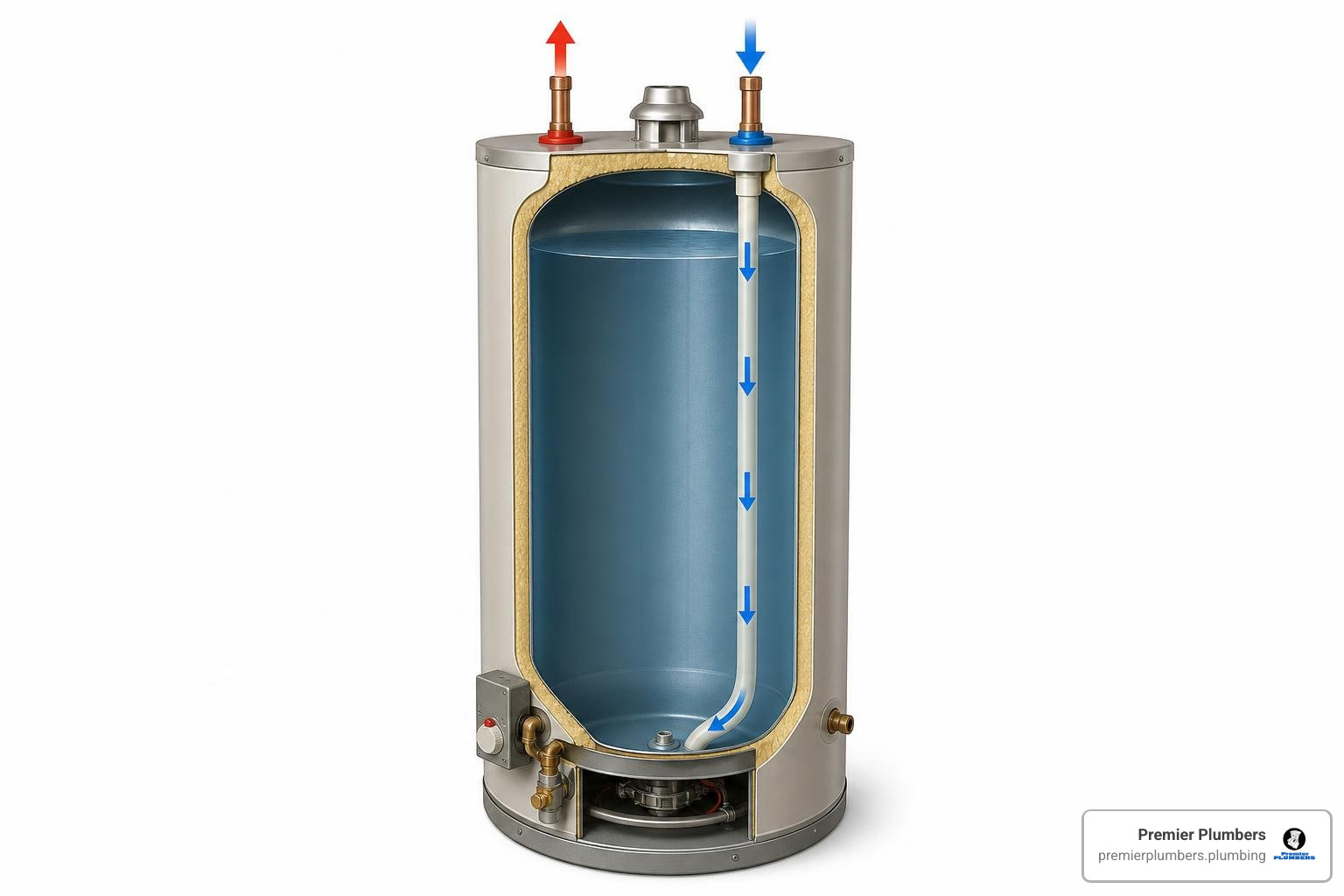
One of the most common mechanical causes of lukewarm water is a broken dip tube. The dip tube is a long plastic pipe that runs from the cold water inlet at the top of the tank all the way down to the bottom. Its job is to deposit cold incoming water at the bottom of the tank, where the burner or lower heating element can heat it. Over time, particularly in older units, this plastic tube can degrade, crack, or break off entirely. When this happens, cold incoming water dumps directly into the top of the tank, mixing with the hot water right before it exits into your home’s pipes, resulting in lukewarm temperatures.
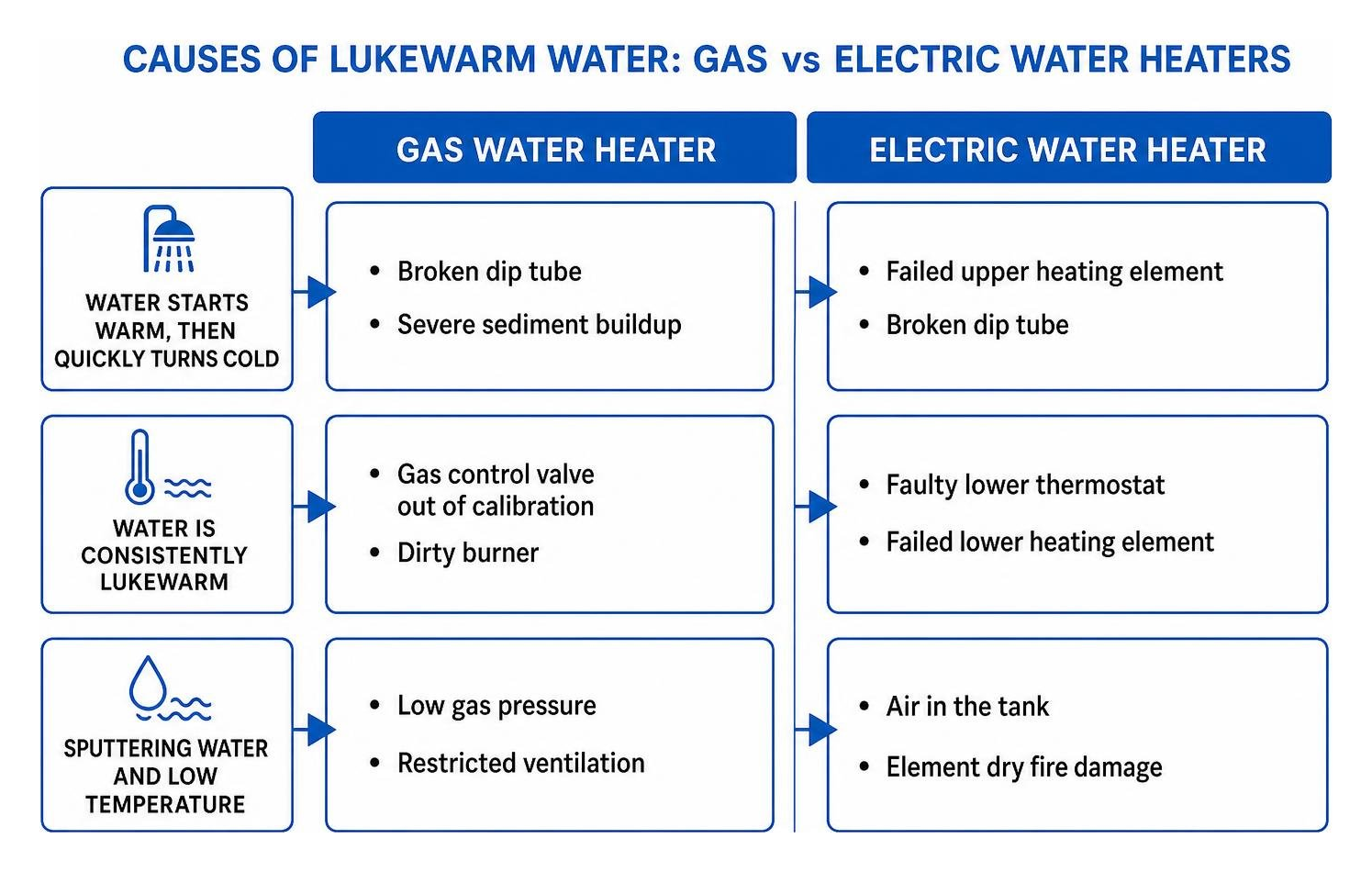
To help you quickly distinguish between electric and gas lukewarm water issues, we have compiled this comparative reference table:
| Symptom | Electric Water Heater Causes | Gas Water Heater Causes |
|---|---|---|
| Water starts warm, then quickly turns cold | Failed upper heating element or broken dip tube | Broken dip tube or severe sediment buildup |
| Water is consistently lukewarm | Faulty lower thermostat or failed lower element | Gas control valve out of calibration or dirty burner |
| Sputtering water and low temperature | Air in the tank or element dry fire damage | Low gas pressure or restricted ventilation |
Faulty Thermostat in an Electric Water Heater Not Heating
Electric water heaters typically utilize two thermostats: an upper thermostat and a lower thermostat. These two devices do not run at the same time; instead, they operate sequentially. The upper thermostat has priority. When the tank is filled with cold water, the upper thermostat sends power to the upper heating element first. Once the top portion of the tank reaches the designated temperature setting, typically set to 120 degrees Fahrenheit, the upper thermostat switches power down to the lower thermostat, which then activates the lower heating element to heat the rest of the tank.
If either of these thermostats fails, the sequential heating cycle is broken. For instance, if the lower thermostat fails, the bottom half of your tank will remain cold. You will get a few minutes of hot water from the top of the tank, but it will rapidly turn lukewarm as the unheated water from the bottom mixes in.
Testing these thermostats requires a multimeter to check for continuity. If you suspect your thermostats are out of calibration or failing to switch power properly, the safest next step is to have the electrical controls inspected before replacing parts.
Failed Heating Element in a Water Heater Not Heating
Just like the thermostats, electric water heaters contain two heating elements: an upper and a lower element. These elements are metal loops that extend directly into the water, heating it through electrical resistance. Because they are constantly submerged in water, they are subject to wear, corrosion, and mineral buildup.
If your lower heating element burns out, you will experience a dramatic reduction in your hot water capacity, resulting in lukewarm showers. If the upper element burns out, the water heater will not heat at all, because the sequential cycle never passes power down to the lower element.
To test your elements, turn off the power at the circuit breaker, remove the access panels, and disconnect the wires from the element terminals. Set your multimeter to Ohms. A functioning 240-volt, 4,500-watt element should show a resistance reading of approximately 12.8 Ohms. If your multimeter reads zero or shows infinite resistance, the element has failed and must be replaced.
It is also vital to avoid a dry fire event. If you turn on the power to a water heater before the tank is completely full of water, the upper element will burn out in a matter of seconds because there is no water to dissipate the heat. If the problem turns into a larger leak, damaged valve, or failed fixture connection, Premier Plumbers can also help with related plumbing repair services that protect the rest of your home’s system.
How Sediment Buildup Affects Performance and How to Flush the Tank
Here in Southwest Florida, from Tampa down to Naples, our water contains high levels of dissolved minerals like calcium and magnesium. When this hard water is heated inside your water heater, these minerals crystallize and settle to the bottom of the tank as sediment.
Over time, this sediment builds up into a thick, crusty layer. In gas water heaters, this sediment acts as a thermal barrier, insulating the water from the burner flame at the bottom of the tank. The burner has to run longer and hotter to heat the water, which wastes energy and can eventually overheat and crack the glass lining of the tank. In electric water heaters, sediment can bury the lower heating element, causing it to overheat and burn out prematurely. You will often hear loud popping, rumbling, or knocking noises coming from your tank, which is the sound of water boiling beneath the sediment crust.
To prevent this damage and restore your heater’s efficiency, we recommend flushing your water heater tank at least once a year. Here is how to perform a standard flush:
- Turn off the power or gas: For electric units, turn off the circuit breaker. For gas units, turn the gas valve to the “pilot” or “off” position.
- Shut off the cold water supply: Close the cold water inlet valve at the top of the tank.
- Attach a hose: Connect a standard garden hose to the drain valve at the bottom of the tank and run the other end to a safe drainage spot outside or into a floor drain.
- Open a hot water faucet: Turn on a hot water faucet upstairs or in a nearby sink to vent the system and allow the water to drain smoothly.
- Open the drain valve: Carefully open the drain valve. Let the water drain completely.
- Pulse the water: Once empty, open the cold water inlet valve in short bursts to stir up and flush out any remaining sediment at the bottom of the tank.
- Refill and restore power: Close the drain valve, disconnect the hose, and let the tank fill completely with water before restoring power or relighting the pilot to prevent dry firing.
Regular maintenance is key to keeping your utility bills low. Annual flushing, anode rod checks, and temperature checks are all part of keeping the appliance efficient, especially in hard-water areas. The Premier Plumbers blog explains why flushing your water heater matters and how routine maintenance helps protect the tank from sediment-related damage.
Repair vs. Replace: When to Call a Professional
Deciding whether to repair a failing water heater or replace it entirely comes down to a few key factors: the age of the unit, the nature of the problem, and the overall cost.
As a general rule, gas water heaters have an average lifespan of 8 to 12 years, while electric water heaters typically last 10 to 15 years. If your water heater is approaching or has exceeded these age thresholds, investing in repairs for major components is often a temporary fix. Minor issues like a faulty thermocouple or a single burned-out heating element are budget-friendly to repair on a newer unit. However, if your tank is actively leaking, this is a clear sign of internal corrosion, and the unit must be replaced immediately to prevent catastrophic water damage to your home.
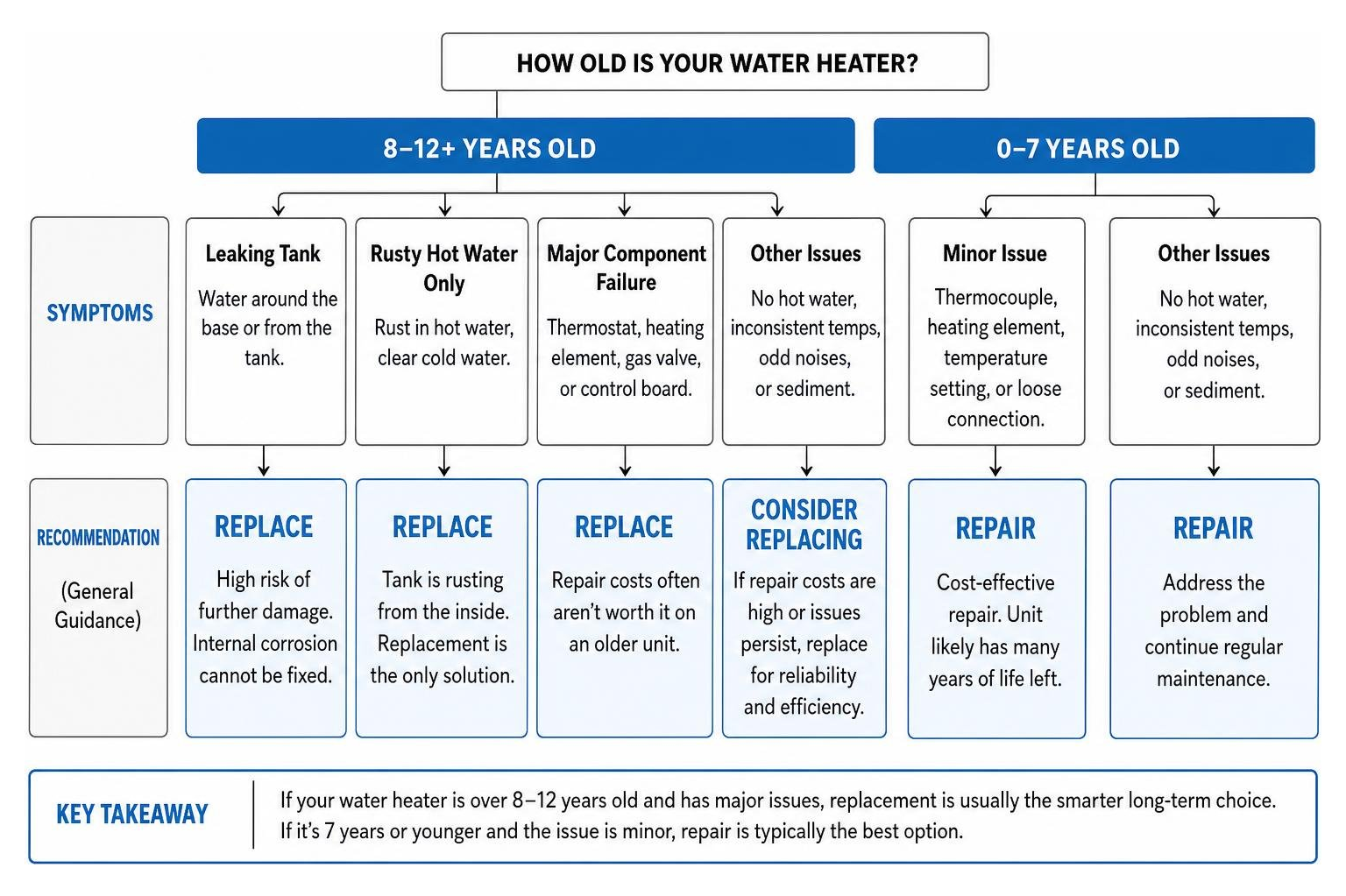
Additionally, if you notice rust in your hot water only, but your cold water runs clear, your water heater tank is rusting out from the inside. When planning a replacement, it is important to understand local building codes. In Florida, municipalities like Collier County and Charlotte County require official building permits and inspections for all water heater installations to ensure safety, proper venting, and thermal expansion compliance.
When considering your options, it helps to compare the cost of repeated repairs with the long-term savings of a more efficient system. The Premier Plumbers blog breaks down why your current water heater is tanking your savings so homeowners can decide when an upgrade to a modern tankless or hybrid heat pump system makes more sense than another short-term repair.
Frequently Asked Questions About Water Heaters
How long does a water heater take to heat up?
The recovery time, which is the time it takes for a water heater to fully heat a cold tank of water, depends on the fuel source and the tank capacity. A standard residential gas water heater typically takes 30 to 40 minutes to heat a full tank. Electric water heaters are slower, generally requiring 60 to 80 minutes to achieve the same result.
What is a dry fire event and how do I prevent it?
A dry fire event occurs when power is restored to an electric water heater before the tank is completely full of water. Without water surrounding the upper heating element, the element will overheat and burn out within seconds. To prevent this, always open a hot water faucet in your home and let it run until water flows in a steady stream with no sputtering air before turning the circuit breaker back on.
Why is my water heater making popping or rumbling noises?
These noises are caused by sediment buildup at the bottom of the tank. As water becomes trapped beneath the mineral crust, it boils and turns to steam, popping and bubbling as it escapes into the cooler water above. A thorough flush of the tank will resolve this issue and restore quiet, efficient operation.
Conclusion
A water heater not heating can quickly turn your daily routine upside down, but many of these issues are preventable with regular maintenance and timely repairs. Whether you are dealing with a tripped breaker, a failed heating element, or heavy sediment buildup, understanding the root cause is the first step toward restoring comfort to your home.
At Premier Plumbers, we are proud of our three-generation legacy of plumbing expertise. As a family-owned team serving Southwest Florida, we bring quality and honest service to every home we visit. If you are tired of cold showers and want a professional, hassle-free resolution, please contact our professional water heater technicians today to schedule your service.