Diagnosing Pipe Failure: Surface Cracks vs. Structural Breakdown
Cast iron pipe repair is viable for localized leaks when more than 75 percent of the pipe wall remains intact, using methods such as epoxy patching or sectional PVC splicing. Full replacement or structural relining is required when lines experience over 25 percent wall loss, channeling, severe cracking, or structural collapse. Determining whether your drainage system requires a targeted patch or an extensive overhaul begins with an accurate physical and visual diagnosis. Cast iron pipes deteriorate from the inside out, which often hides catastrophic thinning beneath a deceptively intact exterior. Before investing time or money into a localized fix, it is critical to evaluate whether the pipe retains enough wall thickness to support a repair.
For more context on the warning signs of an aging system, learn whether old cast iron pipes may be nearing structural failure.
One simple, hands-on diagnostic method for exposed plumbing stacks in crawlspaces or basements is the tapping test. Using the metal handle of a screwdriver or a small mechanic’s hammer, gently tap along the length of the iron pipe:
- A healthy, structurally sound cast iron pipe produces a clear, resonant ringing sound like a heavy bell.
- A pipe compromised by extensive internal decay produces a dull, hollow thud, signaling that the structural integrity is gone and the metal has thinned to paper-like margins.
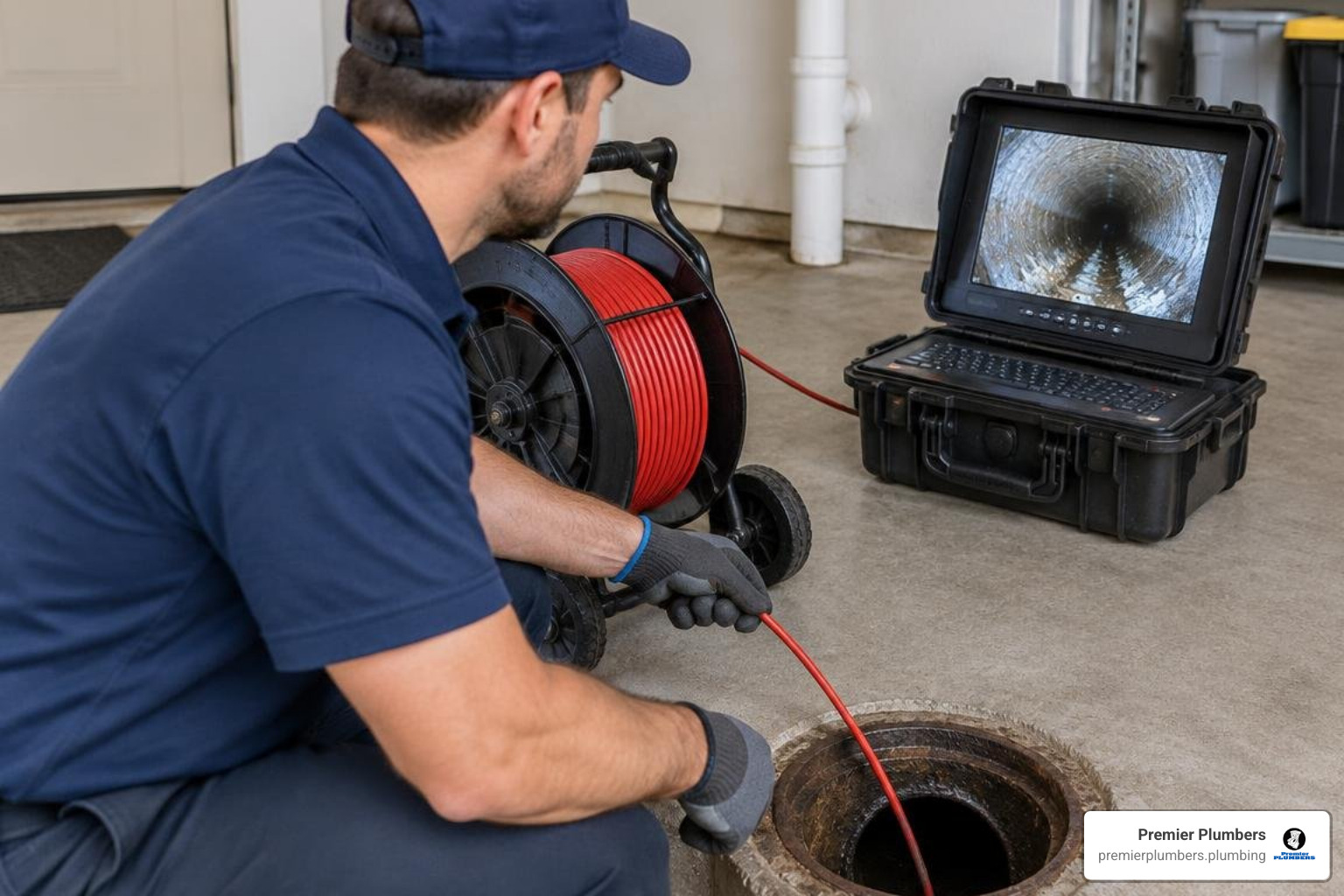
While physical tests give initial clues, a high-definition sewer camera inspection is the gold standard for underground and under-slab lines. In-pipe cameras reveal several common structural failure patterns unique to old iron systems:
- Internal Tuberculation: Mineral deposits and rust mounds build along the inner circumference, catching debris, narrowing the pipe bore, and restricting wastewater flow.
- Channeling: Trickling wastewater and acidic waste scour a deep trench along the bottom interior of horizontal lines. Over decades, this erosion wears the bottom of the pipe completely away.
- Hydrogen Sulfide Corrosion: Bacteria living in sewer lines off-gas hydrogen sulfide, which reacts with condensation to form sulfuric acid. This acid attacks the un-submerged top crown of the pipe, causing rust flaking, structural cracks, and total roof collapse.
Identifying Leaks and Wall Thinning
Pinpointing the exact origin of a leak along an exposed pipe requires clean, deliberate inspection. Moisture can travel along the underside of horizontal runs, making a crack appear inches or feet away from its actual source.
The classic paper towel test eliminates guesswork. Wipe down the entire length of the suspected pipe until completely dry. Wrap clean, white paper towels tightly around the pipe, securing them with painter’s tape. Run wastewater through the fixture above; water stains on the paper towel will pinpoint hairline stress fractures, loose lead-and-oakum hub joints, or hidden pinhole leaks.
When moisture is trapped inside walls, subfloors, or beneath concrete slabs, professional plumbers utilize thermal imaging and non-invasive moisture mapping meters. These tools measure the spread of water damage behind building materials without requiring immediate demolition.
A critical rule of thumb in plumbing diagnostics is the 25 percent wall loss threshold. If more than a quarter of the pipe wall has dissolved due to internal rust or exterior flaking, localized surface patching will fail. At that stage of degradation, clamping or applying putty to the pipe will only shift mechanical stress to the adjacent brittle metal, triggering another leak nearby.
Proven Methods for Cast Iron Pipe Repair
When diagnostics confirm that the host pipe retains enough healthy metal, homeowners and technicians can use several proven methods to seal leaks and restore wastewater flow.
For sudden leaks that threaten property damage, Premier Plumbers provides emergency plumbing repairs while the team determines the safest long-term solution.
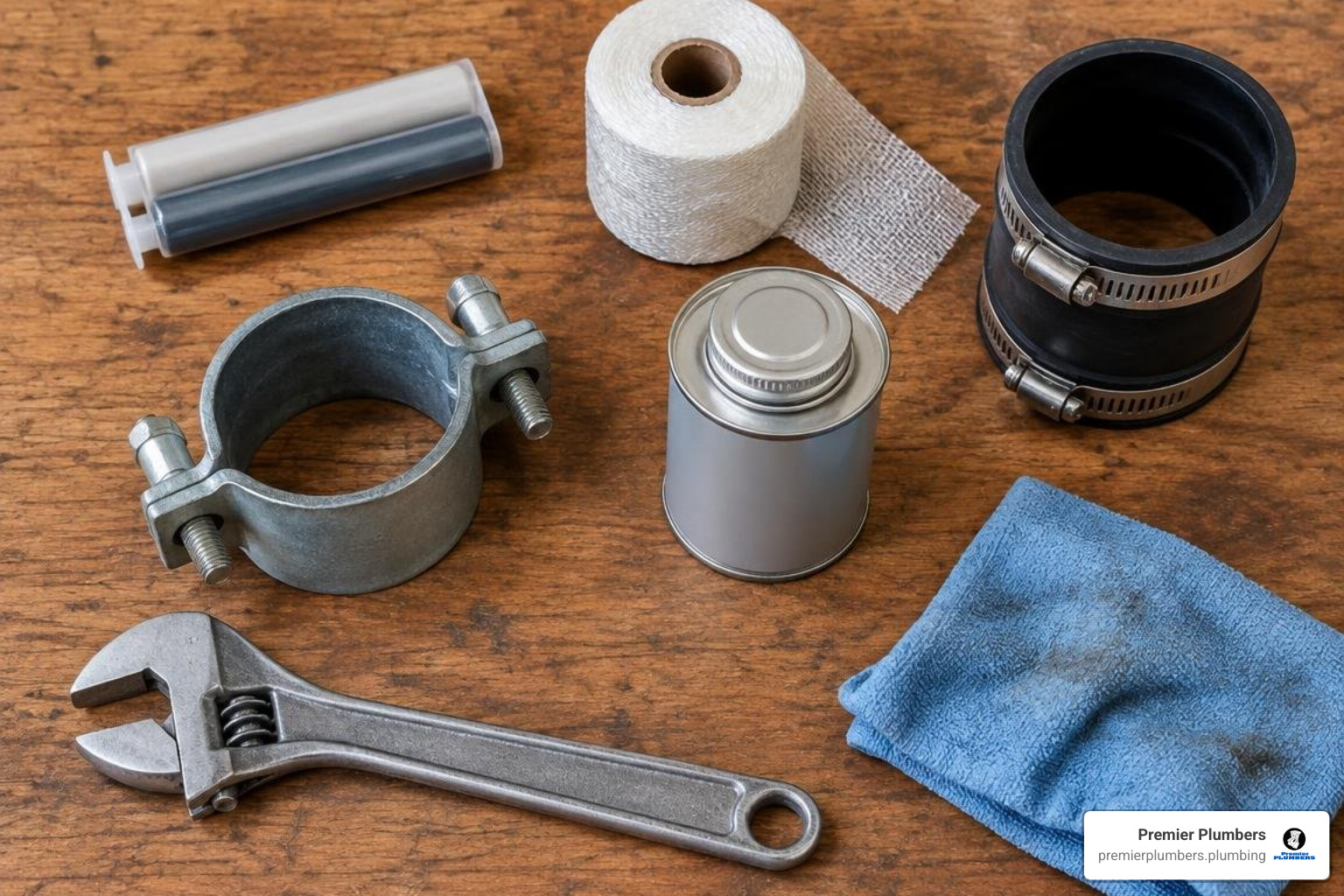
Short-term, localized fixes are best suited for accessible, non-pressurized drain, waste, and vent (DWV) lines showing isolated hairline cracks or pinhole leaks. For minor emergencies, applying a two-part epoxy putty combined with a moisture-cured fiberglass wrap creates a rigid shell that halts moisture penetration. However, these surface applications must be treated as temporary measures while scheduling permanent structural restoration.
Surface Preparation and Epoxy Patching for Cast Iron Pipe Repair
No chemical adhesive or epoxy patch can bond to oxidized, dirty metal. Proper surface preparation is the single most critical step in achieving a watertight seal.
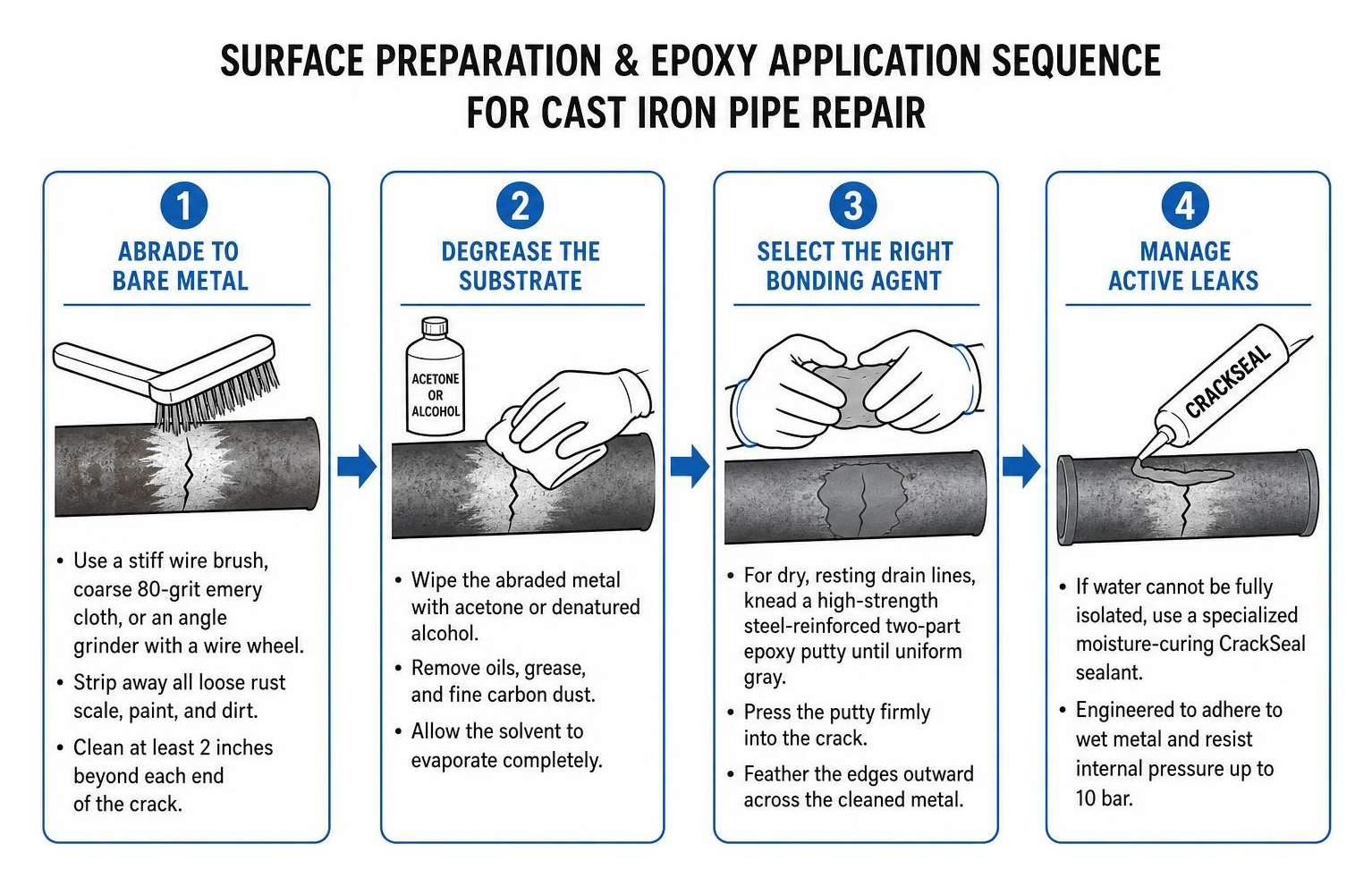
To prepare cast iron for an adhesive patch, follow this precise sequence:
- Abrade to Bare Metal: Use a stiff wire brush, coarse 80-grit emery cloth, or an angle grinder fitted with a wire wheel to strip away all loose rust scale, exterior paint, and dirt around the crack. Extend the cleaning zone at least two inches beyond the visible ends of the fracture.
- Degrease the Substrate: Wipe the abraded metal thoroughly with acetone or denatured alcohol to remove oils, grease, and fine carbon dust. Allow the solvent to evaporate completely.
- Select the Right Bonding Agent: For dry, resting drain lines, knead a high-strength steel-reinforced two-part epoxy putty until it turns a uniform gray color. Press the putty firmly into the crack, feathering the edges outward across the cleaned metal.
- Manage Active Leaks: If water cannot be completely isolated, use a moisture-curing sealant and follow the manufacturer’s application instructions for wet-metal conditions.
- Reinforce and Cure: For added structural hoop strength, wrap the patched area with a water-activated fiberglass bandage. Standard epoxy putty forms a functional cure in 30 to 45 minutes, with full chemical cure achieved in 24 hours. A properly applied epoxy patch on a sound, non-pressurized drain line can last 5 to 10 years.
Mechanical Clamps and Sectional PVC Replacements in Cast Iron Pipe Repair
When a localized section of cast iron has suffered severe cracking, rot, or localized impact damage, cutting out the compromised segment and splicing in modern Schedule 40 PVC is a vastly superior solution to surface pastes.
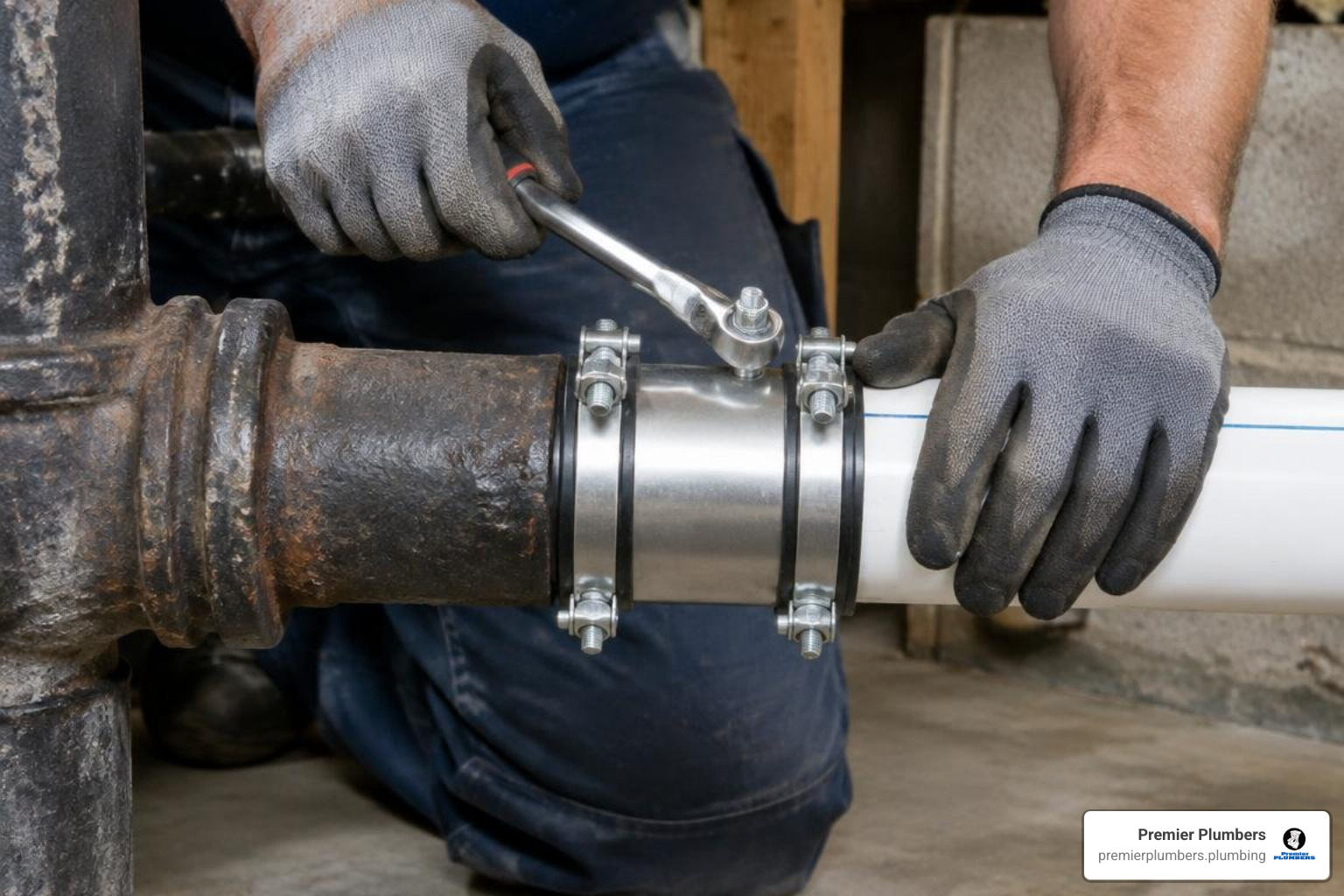
This mechanical sectional repair involves the following steps:
- Stabilize and Support: Cast iron is exceptionally heavy. Secure the pipe stack above and below the repair zone using heavy-duty riser clamps, pipe hangers, or timber blocking to prevent the vertical stack from dropping when cut.
- Execute Precision Cuts: Mark the cut points at least two inches past the damaged zone into healthy, thick pipe wall. Use a hydraulic snap cutter, or a reciprocating saw fitted with a diamond-grit or thick carbide-tipped cast iron blade. Run the saw at medium speed to avoid overheating and pipe shattering.
- Measure and Cut Replacement Pipe: Measure the open gap between the cut cast iron ends and subtract 1/4 inch to allow for thermal expansion and fitting clearance. Cut an identical length of cellular-core or solid Schedule 40 PVC pipe, deburring the internal and external cut edges.
- Install Shielded Couplings: Slide heavy-duty shielded no-hub couplings, often called transition couplings, over the pipe ends. Unlike thin, unshielded rubber sleeves that can deform or allow pipe shearing under soil pressure, shielded couplings feature a thick neoprene gasket wrapped in a corrugated stainless steel band.
- Torque to Specification: Position the PVC segment into the run and slide the shielded couplings over the joints. Using an alternating pattern across the band screws, tighten the assembly with a calibrated 60 in-lb torque wrench. This ensures an even, rigid, 360-degree seal that prevents internal misalignment or step edges that snag waste.
When damage extends beyond one isolated section, cast iron pipe replacement services can address broader structural failure.
Homeowners comparing repair with a larger restoration project can also see how cast iron pipe replacement works in Southwest Florida.
Trenchless Pipe Relining: A No-Dig Alternative
For buried sewer lines running beneath landscaping, driveways, or finished home interiors, traditional excavation is no longer the only way to replace failing plumbing. Trenchless cured-in-place pipe (CIPP) relining creates a brand-new, structurally independent pipe directly inside the failing cast iron host pipe without requiring trenching.
For homeowners who are candidates for a no-dig repair, Premier Plumbers offers trenchless pipe lining services that begin with a detailed inspection of the line’s condition and slope.
For a closer look at the process and its ideal applications, understand the benefits and limits of no-dig pipe relining.
The CIPP relining process follows a rigorous mechanical workflow:
- Hydro-Jetting and Descaling: Technicians insert high-pressure water jets and specialized mechanical chain knockers through an existing cleanout. This equipment scours away decades of rust tubercles, grease, and scale, restoring the pipe’s internal diameter to a smooth circular profile.
- Video Inspection and Calibration: A camera verifies that all debris is cleared, measures the precise line length, and marks the locations of incoming lateral branch lines.
- Liner Impregnation: A seamless, flexible felt or fiberglass tube tailored to the pipe diameter is saturated with a two-part structural epoxy resin under controlled vacuum pressure.
- Inversion and Curing: The saturated liner is inverted or pulled into the host pipe via an access point using air or water pressure. Once in place, the liner is cured using ambient air, hot water, steam, or UV light systems. The epoxy hardens into a smooth, jointless conduit within a few hours.
- Robotic Reinstatement: If secondary fixtures join the main line along the relined section, a robotic cutter navigates inside the pipe to precisely mill open those lateral connections.
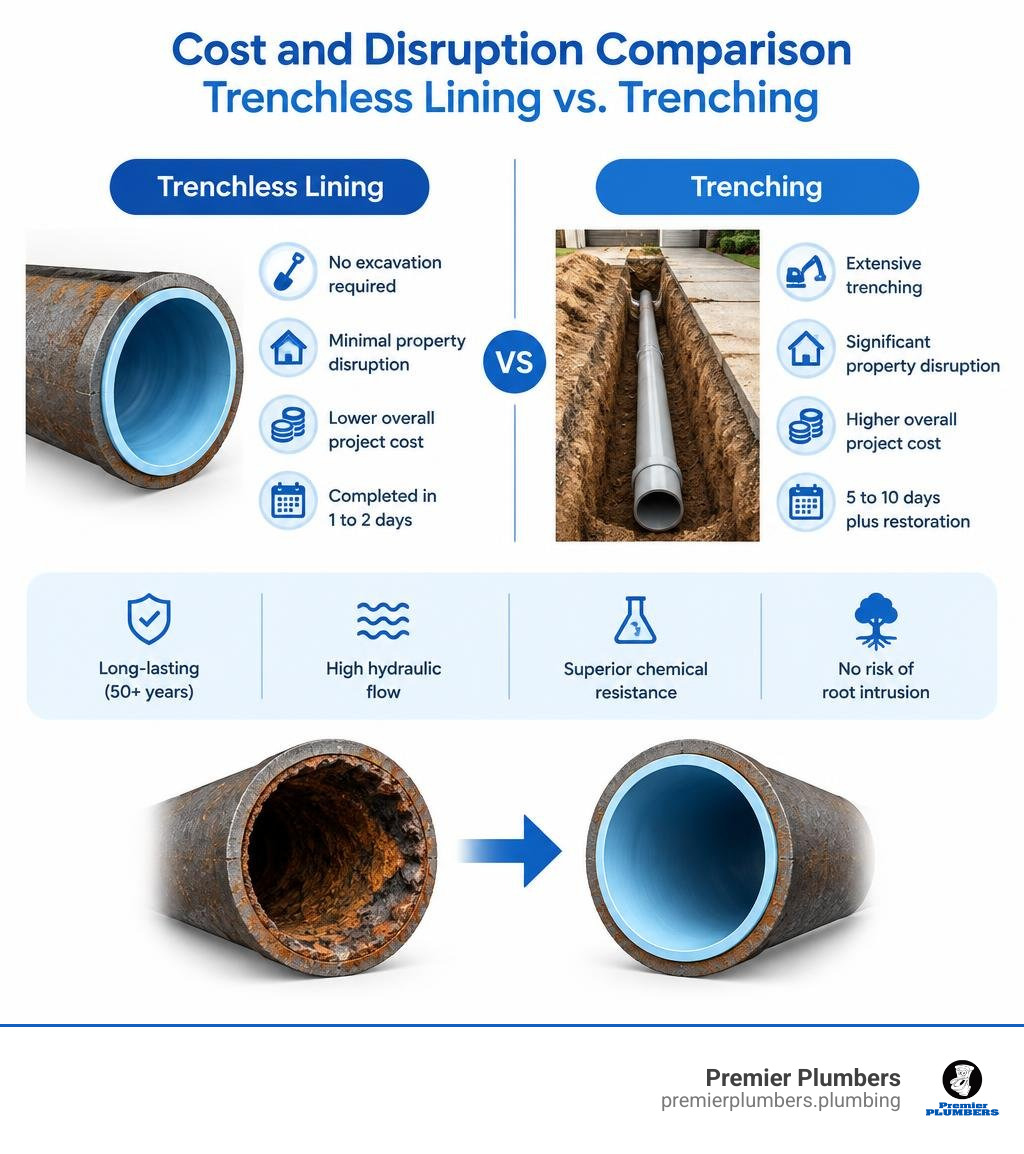
| Feature | Trenchless CIPP Relining | Traditional Trench Excavation |
|---|---|---|
| Excavation Required | None to minimal (single access point or cleanout) | Extensive trenching through floors or yards |
| Structural Design Life | 50+ years | 50+ years (with modern PVC) |
| Property Disruption | Low; completed in 1 to 2 days | High; 5 to 10 days plus restoration |
| Hydraulic Flow | High; ultra-smooth interior surface | High; smooth PVC interior surface |
| Overall Project Cost | Lower (eliminates floor and yard rebuilding) | Higher due to extensive structural restoration |
When Trenchless Solutions Outperform Dig-and-Replace
Trenchless CIPP relining provides immense value when failing cast iron runs beneath monolithic concrete slab foundations, high-end tile, custom cabinetry, or mature outdoor landscaping. In these scenarios, the cost of demolishing floors and rebuilding living spaces often dwarfs the plumbing bill itself. Opting for no-dig solutions can reduce the total project cost by avoiding extensive property reconstruction.
Epoxy-lined pipes can also improve resistance to corrosion, acidic drain fluids, and root intrusion when the host pipe is an appropriate candidate for relining.
When to Stop Repairing and Choose Full Replacement
While epoxy patches and trenchless liners are exceptional problem solvers, they are not universal cures. In certain advanced stages of system failure, continuing to patch or attempting to line old iron is a poor use of resources.
Full physical excavation and pipe replacement is mandatory in the following situations:
- Severe Pipe Collapse or Crushing: If the top crown of the cast iron has caved in or the pipe has been crushed by soil compaction, an inversion liner cannot pass through or expand into a round shape.
- Extensive Back-Pitch and Sagging Bellies: Relining follows the contour of the existing host pipe. If shifting soils have created low spots, called bellies, where standing water pools, a liner will simply lock that improper slope into place. The line must be excavated, re-graded to a minimum 1/4-inch per foot drop, and replaced.
- Complete Channeling with Missing Sub-Base: When the bottom of the cast iron has completely dissolved and the underlying soil has washed away, creating large voids under the foundation, excavation is required to stabilize the earth and install modern PVC.
- Extreme Displaced Joints: Offsets where adjoining pipe sections have disconnected by several inches require physical alignment that cannot be bridged safely with internal sleeves.
When structural deterioration affects water supply lines and drain lines across the entire property, Premier Plumbers can assess whether whole-home repiping is the most reliable long-term option.
Homeowners planning a broader upgrade can also learn what to expect from a complete whole-home repiping project.
Frequently Asked Questions About Cast Iron Plumbing
How long does an epoxy patch or CIPP relining last?
A localized, two-part epoxy patch applied to an abraded, non-pressurized cast iron drain line typically lasts 5 to 10 years, assuming the remaining pipe wall retains sufficient thickness. In contrast, professional structural CIPP pipe relining creates a brand-new, jointless inner pipe engineered for a design life of 50 years or more, effectively rivaling the lifespan of brand-new PVC pipe.
Can you repair a leaking cast iron pipe while water is flowing?
Yes, using specialized moisture-curing sealants and water-activated fiberglass wraps engineered for wet applications. Products like moisture-tolerant polymer sealants can cure underwater and withstand pressures up to 10 bar. However, for long-term structural repairs involving two-part epoxy putty, no-hub couplings, or trenchless liners, water flow should always be stopped completely to ensure proper surface adhesion and seal formation.
How does coastal soil accelerate cast iron corrosion in Venice?
Venice and surrounding Southwest Florida coastal communities feature high water tables containing brackish, saline moisture and sandy soil. Salt acts as an electrolyte, accelerating galvanic and electrochemical corrosion on the exterior of buried cast iron. Combined with warm ambient temperatures and high internal sewer gas humidity, coastal iron pipes corrode significantly faster than those in dry, inland regions.
Conclusion
Determining whether to perform a localized patch, install a structural liner, or complete a full drain line replacement requires a professional assessment of your pipe’s remaining wall thickness and structural condition. While temporary epoxy sealants and mechanical couplings are excellent for stopping minor, isolated leaks, they cannot fix systemic internal rot, ground shifts, or bottom-channel erosion.
Premier Plumbers brings three generations of hands-on expertise to every diagnostic camera inspection and plumbing restoration project across Sarasota, Manatee, Charlotte, Lee, and Collier counties. If your home has aging cast iron plumbing, contact our cast iron pipe repair specialists to schedule a complete camera inspection and help keep your plumbing dependable for decades to come.