What Is Pipe Lining? (And Why Florida Homeowners Need to Know)
Pipe lining is a trenchless method of repairing damaged underground pipes from the inside. There is no need to dig up your yard or break through concrete floors.
Quick answer: Here’s what you need to know at a glance:
| Question | Answer |
|---|---|
| What is it? | A flexible, resin-soaked liner inserted into a damaged pipe and cured to form a new pipe inside the old one |
| Who is it for? | Homeowners with cracked, corroded, or root-damaged sewer or drain pipes |
| How long does it take? | Most jobs are done in 1-2 days |
| How long does it last? | 50+ years with proper installation |
| How much does it cost? | Typically 30-50% less than traditional dig-and-replace |
| Is digging required? | No. Existing access points are used |
Your sewer line is failing. You’ve got two options in front of you: tear up your yard and driveway, or fix the pipe from the inside without touching your landscaping. For most Florida homeowners dealing with aging cast iron drains, root intrusion, or recurring backups, pipe lining is the smarter, faster, and less expensive path forward.
This guide covers everything you need to make a confident decision, from how the process works, to costs, to when it’s not the right solution.
At Premier Plumbers, our licensed plumbing team brings a three-generation legacy and decades of hands-on experience to pipe lining projects across Southwest Florida, restoring pipes in homes ranging from older cast iron systems to modern PVC lines. That team experience is the foundation of everything you’ll read here.
What is Pipe Lining and How Does It Work?
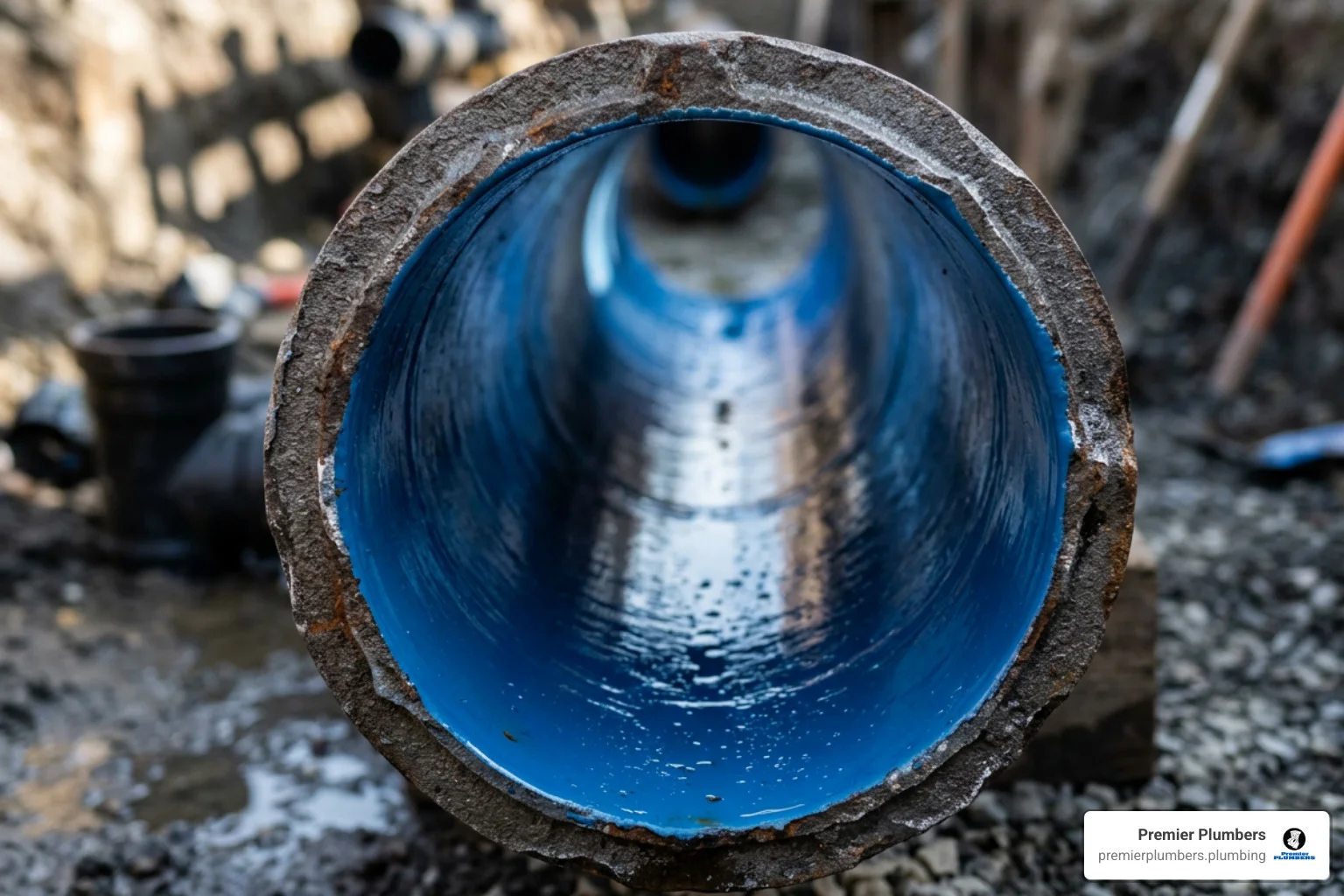
Cured-In-Place Pipe (CIPP) lining is a structural rehabilitation technique that essentially creates a seamless, jointless “pipe-within-a-pipe.” Instead of digging a massive trench to remove and replace a damaged sewer line, we use the existing damaged pipe as a host structure.
A flexible felt or fiberglass tube, thoroughly saturated with a high-strength epoxy resin, is guided into the damaged line. Once in position, the liner is inflated against the inner walls of the host pipe and allowed to cure (harden). The result is a smooth, structurally independent barrier that seals off cracks, bridges missing pipe sections, and prevents root intrusion.
There are two primary methods we use to insert the liner depending on the layout of your plumbing:
- The pull-in-place method: This technique is ideal for pipes with multiple bends, elbows, or transitions. The resin-saturated liner is physically pulled into position from one access point to another using a cable. This allows for highly precise positioning in complex residential systems.
- The inversion method: Commonly used for straight, longer runs, this method uses compressed air or water pressure to literally “roll” the resin-coated liner inside out into the pipe. The wet side of the liner is pressed directly against the inner walls of the host pipe as it unrolls.
For homeowners comparing options, our professional pipe lining services explain how Premier Plumbers customizes these trenchless methods for homes across Southwest Florida.
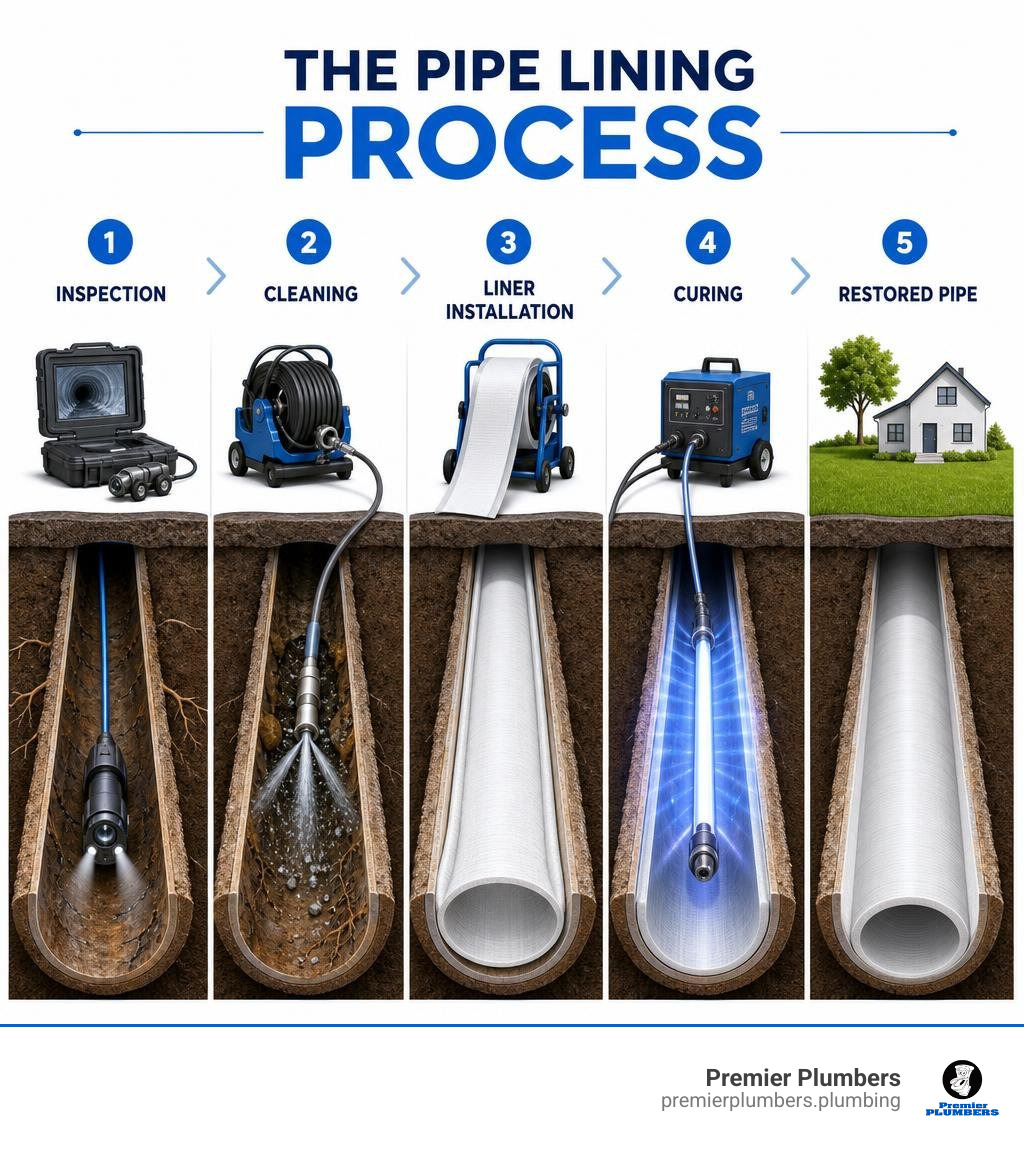
The Step-by-Step CIPP Process
A successful CIPP project requires precise execution. Here is exactly what happens when our team arrives at your property:
- Initial camera inspection: We never guess what is happening underground. We begin by performing high-definition video sewer inspections to map out the exact location of cracks, structural offsets, root blockages, or collapsed sections.
- Mechanical cleaning and prep: Before lining, the host pipe must be restored to its original internal diameter. We use specialized mechanical cutters and high-pressure hydro jetting to strip away decades of rust scale, grease build-up, and tree roots.
- Liner preparation (wet-out): The felt liner is measured to exact specifications and saturated with a two-part epoxy resin. This is done on-site to ensure the resin remains highly workable.
- Insertion and inflation: The liner is inserted into the pipe using either the pull-in-place or inversion method. Once in position, a temporary calibration bladder (balloon) inside the liner is inflated with air or water, pressing the epoxy firmly against the host pipe’s walls.
- Curing: The epoxy is allowed to cure. While ambient curing is common, we can use heat or specialized UV light systems to dramatically reduce curing times to just a few hours.
- Bladder removal and reinstatement: Once the epoxy has hardened into a structural shell, the bladder is deflated and removed. If there are any lateral connections (like branch lines from toilets or sinks) that were covered by the liner, we use a robotic cutter to precisely reopen them from the inside.
- Final camera inspection: We run our camera through the newly lined pipe one last time to verify a smooth, seamless finish and provide you with visual proof of the completed repair.
Materials and Environmental Safety
When it comes to the safety of your family and the local Florida environment, the materials we use matter. Quality epoxy resins are engineered to meet strict ASTM-F1216 and ASTM D-5813 structural standards.
Once fully cured, the epoxy is completely inert, meaning it does not leach harmful volatile organic compounds (VOCs) or chemicals into the surrounding soil or water table. For drinking water applications, we utilize specialized resins certified under NSF/ANSI 61 standards, ensuring that professional pipe lining is completely safe for potable water lines as well as sanitary sewers.
Comparing Trenchless Pipe Lining to Traditional Excavation
To fully appreciate why trenchless technology has revolutionized the plumbing industry, it helps to look at the numbers and the physical reality of both methods.
| Feature | Trenchless Pipe Lining (CIPP) | Traditional Excavation (Dig-and-Replace) |
|---|---|---|
| Property Disruption | Minimal (uses existing access points) | Heavy (trenching through yards, driveways, floors) |
| Project Timeline | 1-2 days | 5-7+ days (excluding restoration) |
| Yard/Hardscape Damage | Zero to minimal | Extensive (requires heavy machinery) |
| Expected Lifespan | 50+ years | 50+ years |
| Overall Cost | High upfront, but saves 30-50% overall | Lower upfront, but high restoration costs |
For homeowners in the Gulf Coast region, choosing trenchless sewer repair in Sarasota often means the difference between a quick weekend project and a multi-week construction nightmare.
Key Benefits of Trenchless Pipe Lining
- Landscaping preservation: Traditional sewer replacement requires digging a trench directly over your sewer line. If that line runs beneath your manicured lawn, a concrete driveway, or a beautiful pool deck, those features will be destroyed. Trenchless lining preserves your hardscaping and landscaping.
- Rapid completion: Most residential trenchless pipe lining projects are completed in just 1 to 2 days, whereas full excavation can easily drag on for a week or more.
- Significant financial savings: While the upfront cost of the lining material and specialized equipment is higher, factoring in the cost of replacing ruined concrete, sod, and interior flooring makes pipe lining 30% to 50% cheaper overall.
- Jointless, root-proof design: Because the finished liner is a single, continuous tube, it eliminates the joints and seams where tree roots typically find their way into your sewer system.
When Traditional Excavation is Better
As much as we love trenchless technology, it isn’t a magic wand for every plumbing disaster. There are specific situations where a traditional sewer line replacement is the only viable option:
- Severely collapsed pipes: If a pipe has completely collapsed or flattened, there is no structural pathway left to insert a liner.
- Severe offsets or bellies: If the ground has shifted and created a massive “belly” (sag) in the line, or if the pipe sections have completely separated, lining will simply follow the bad slope. Excavation is required to correct the grade.
- Undersized pipes: If your home’s waste demands have grown and you need to upsize the physical diameter of the sewer line, lining is not appropriate as it slightly reduces the internal diameter.
Pipe Materials, Lifespan, and Project Costs
Southwest Florida is famous for its beautiful mid-century and historic homes, particularly in areas like Sarasota, Bradenton, and Fort Myers. Many of these properties still rely on original cast iron or clay sewer lines.
Over time, cast iron pipes suffer from “channeling” (where the bottom of the pipe corrodes away) and internal scaling, while clay pipes are highly susceptible to shifting and root intrusion. Fortunately, modern epoxy lining is fully compatible with cast iron, clay, PVC, concrete, and even old Orangeburg pipes. If you are dealing with failing metal drains, cast iron pipe relining in Sarasota can save you from having to jackhammer your home’s concrete slab.
For related homeowner education, Premier Plumbers explains when pipe rehabilitation can help in our cast iron pipe relining article, and our sewer repair resources show how recurring backups, root intrusion, and aging underground drains are evaluated before recommending lining or replacement.
Compatible Pipe Types and Conditions
We can successfully perform sewer pipe relining on a wide variety of materials and pipe conditions:
- Cast iron: Seals off rusted bottoms and stops internal scaling.
- Clay: Bridges cracked joints and completely blocks invasive tree roots.
- PVC / ABS: Repairs structural cracks or failing joints without excavation.
- Concrete and storm drains: Seals structural cracks and stops groundwater infiltration.
- Large gaps: The structural strength of epoxy allows the liner to span large physical gaps where the original host pipe has completely corroded away.
Lifespan and Warranty Expectations
How long does a lined pipe actually last? Quality CIPP systems are engineered to last 50 years or more under normal residential operating conditions. Because the cured epoxy resists chemical corrosion and physical wear far better than cast iron or clay, it provides a permanent, long-term solution.
At Premier Plumbers, we stand behind our work with robust warranties, often providing transferable coverage that adds significant resale value to your home if you decide to sell.
Cost Factors of a Pipe Lining Project
When budgeting for a trenchless repair, several variables will influence the final estimate:
- Linear footage: Pricing is often calculated per foot, meaning longer runs will naturally cost more.
- Pipe diameter: Standard residential lines (typically 1.5” to 6”) require different equipment and resin volumes than larger commercial mains.
- Access points: If we can access the line through an existing cleanout, roof vent, or toilet flange, costs remain lower. If we must excavate a small access pit, that will add to the labor.
- Pre-lining prep: Pipes with heavy root intrusion or severe scale buildup require extensive mechanical cleaning and drain cleaning services before the liner can be safely installed.
Frequently Asked Questions about Trenchless Pipe Repair
To help you make an informed decision, we have compiled answers to some of the most common questions we receive from homeowners in Sarasota, Fort Myers, Tampa, and the surrounding areas.
How long does the pipe lining process take?
Most residential projects are completed in 1 to 2 days. The actual physical installation and curing of the liner typically take just a few hours. During this time, we ask that you limit water usage (no running showers, washing machines, or flushing toilets) to ensure no wastewater enters the line while the resin is curing. Once the liner is fully cured and inspected, your water service is fully restored.
Does homeowners insurance cover pipe lining?
In most cases, standard homeowners insurance policies do not cover gradual wear-and-tear, corrosion, or aging pipes. Therefore, pipe lining is typically an out-of-pocket home maintenance expense. However, if your pipe suffered sudden, accidental damage (such as from a sudden soil collapse or lightning strike), your policy might assist with a portion of the repair. We always recommend reviewing your specific policy and speaking directly with your insurance provider.
Will pipe lining reduce the flow capacity of my drains?
While the physical liner does reduce the internal diameter of your pipe by a very small margin (typically about 5%), it actually improves your overall flow rate. The interior surface of cured epoxy is incredibly smooth and slick compared to rough, corroded cast iron or clay. This drastically reduces friction, allowing waste to flow more efficiently and significantly reducing the risk of future clogs.
Conclusion
When you are facing a sewer line crisis, you do not have to settle for a ruined yard and weeks of stressful construction. Trenchless pipe lining offers a highly durable, cost-effective, and minimally invasive alternative that restores your plumbing system for the next half-century.
At Premier Plumbers, we bring a three-generation legacy of plumbing expertise and quality service to every single project we handle across Southwest Florida. Whether you are in Sarasota, Bradenton, Fort Myers, Naples, Port Charlotte, or Tampa, our licensed and certified team has the specialized training and cutting-edge equipment needed to get the job done right the first time.
Don’t let a damaged pipe disrupt your home or drain your budget. Contact our professional pipe lining technicians and let our family take care of yours.
Local Service Areas
We proudly serve homeowners throughout Southwest Florida, including:
- Sarasota County: Sarasota, Venice, North Port, Siesta Key, Osprey
- Manatee County: Bradenton, Palmetto, Lakewood Ranch, Anna Maria Island
- Lee County: Fort Myers, Cape Coral, Bonita Springs, Estero, Sanibel Island
- Collier County: Naples, Marco Island, Golden Gate
- Charlotte County: Port Charlotte, Punta Gorda
- Hillsborough County: Tampa, Brandon, Riverview, Lutz