
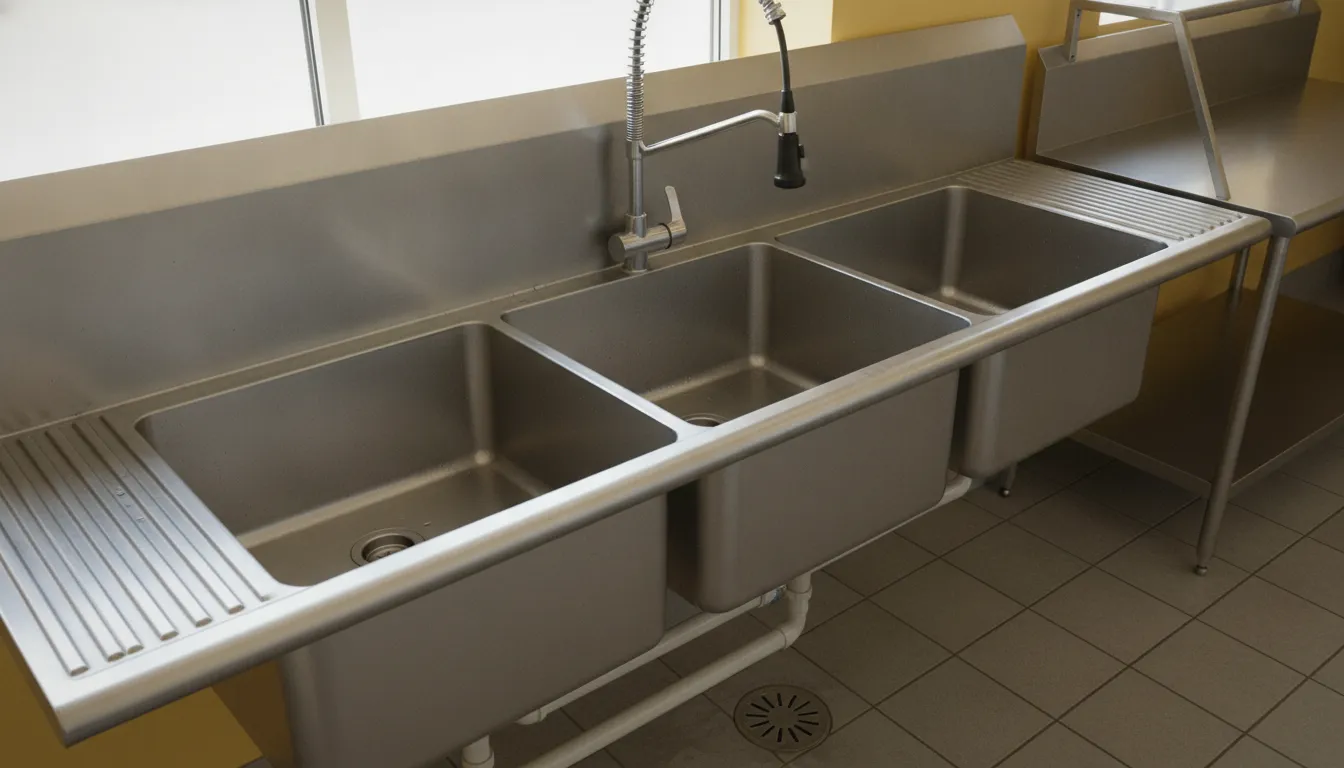
Restaurant sink plumbing requirements are a short list a property owner can check with a tape measure before the walls close. If the kitchen serves food to the public in Florida, three things have to be true. The wash sink has to fit the biggest pot. Each basin needs its own drain, with a visible gap above the floor sink. The hand sink has to be a separate fixture. Miss one of those and the opening inspection can stop the project while the cook line is already built.
Request a plumbing visit for the kitchen
This is the practical version for someone who owns the building, holds the lease, or is opening a small food business on Florida’s Gulf Coast. Premier Plumbers does general plumbing for homes and for commercial customers from Tampa to Marco Island. A restaurant sink rough-in is commercial plumbing. It is not a fixture you pick up in the Sarasota showroom, which is residential only. Your local plumbing official and the Division of Hotels and Restaurants still approve the plans. What follows is how to read those rules before you spend money on the wrong sink.
What Restaurant Sink Plumbing Requirements Cover
Start with the sink that washes pots, pans, and utensils. Florida’s Division of Hotels and Restaurants says a three-compartment sink must be large enough to submerge the largest piece of equipment in each step: wash, rinse, and sanitize. That answer was updated in September 2025, and it points back to the Florida Food Code. It is not a suggestion from a catalog.
You also need two drainboards, one at each end, or racks mounted above the sink that do the same job. Dirty ware sits on one side. Clean ware air-dries on the other. A backsplash guard keeps splashes off the wall and makes the area easier to wipe down. Nearby storage has to be large enough that clean kitchenware can air-dry instead of being towel-dried and put away wet.
If your largest sheet pan or stock pot does not go fully under the water in every bay, the sink fails even when the steel looks new. Measure the pan you actually use on a busy night, not the one in the brochure.
The division’s opening checklist expects that sink, and its drainboards, to be installed and working before the licensing inspection. Hot and cold holding, handwashing supplies, backflow protection on faucets, and cleanable floors and walls sit on that same list. A new sink with no hot water is still a failed visit. So is a threaded faucet with no backflow device. Read the official answers before you order the fixture.
- DBPR’s three-compartment sink requirements
- The fixed public food service opening checklist (Form HR 5024-017)
The hand sink is its own fixture
A three-compartment sink does not replace a hand sink. Food workers need a dedicated handwashing sink with soap, a way to dry hands, and a sign. Do not plan to wash hands in the warewashing bays or in a prep sink. Inspectors look for that split because a shared basin mixes hand soil with the wash, rinse, or sanitize water.
Prep sinks, mop sinks, and bar glass washers each have their own job. A bar that washes glasses by hand often needs its own three-compartment setup, or an approved dishwasher, sized for the glass rather than a sheet pan. Label which sink does which job on the plan so the reviewer is not guessing.
How Restaurant Sink Plumbing Requirements Shape the Drain
The fixture is only half the job. Under the 2023 Florida Building Code, Plumbing, food-handling equipment and dishwashing sinks send water out through an indirect waste pipe. Section 802.1.1 has two parts. Equipment used to store, prepare, or handle food has to drain across an open gap. Each well of a multi-bay sink has to drain on its own to a waste receptor.
Three bays means three outlets. Connecting all three compartments to one tailpiece and dropping that into a single trap is a common shortcut, and it is the one reviewers mark up. If one bay clogs, dirty water can back up into the other two. The open gap stops that water from being pulled back toward the food-contact side.
The code sets that gap at not less than twice the effective opening of the indirect waste pipe. Measure it to the flood rim of the receptor. A floor sink with a grate, set where staff can see it and clean it, is the usual receptor. The receptor itself is trapped and vented, then tied to the building drain. If the indirect pipe runs longer than 30 inches horizontally, or 54 inches in total developed length, that indirect pipe has to be trapped too.
Air gap versus air break
An air gap is open space. The pipe ends above the rim, and you can see daylight between the outlet and the water. An air break ends below the rim but above the trap seal, so it stops a siphon without the same open gap. For food-handling fixtures, Section 802.1.1 calls for the air gap. A later line, Section 802.1.7, allows a food-utensil sink to discharge indirectly through an air gap or an air break. Do not treat those two sentences as the same fitting. Ask the plumbing official which one your permit requires, and do not let a sketch swap the words.
Floor drains inside a walk-in cooler or freezer also go indirect, by an air gap, when they serve a food establishment. There is a narrow exception when a backwater valve protects the drain, and then an air break or an air gap may be accepted. That exception is for the walk-in floor drain. It is not permission to hard-pipe the three-compartment sink straight into the sanitary stack.
The wording lives in Chapter 8 of the 2023 Florida Building Code, Plumbing. Local amendments and the plumbing official’s reading of the permit still control what gets built.
When a Grease Interceptor Changes the Hookup
Most kitchen drains still need a grease interceptor. Chapter 10 says interceptors go in where oil, grease, sand, or other harmful material would otherwise reach the public sewer or a private treatment system. The plumbing official approves the size, type, and location. If the interceptor sits on a septic system, the health official approves it too. Waste that does not need treatment stays out of the interceptor.
Owners often mix that rule up with the indirect-waste rule. There is one plumbing-code path that lets a warewashing sink connect directly. Section 1002.1, exception 4, allows a food utensil, dish, pot, and pan sink to connect directly to a hydromechanical grease interceptor. The installation has to follow the manufacturer’s instructions. The branch that serves that interceptor also needs an emergency floor drain downstream of the interceptor connection. That branch may serve only the emergency floor drain and the interceptor.
The same exception adds a length limit when the interceptor serves a combination sink of not more than three compartments. The vertical distance from the fixture outlet to the interceptor inlet cannot exceed 30 inches. The developed length of the waste pipe from the most upstream fixture outlet to the interceptor inlet cannot exceed 60 inches. Step outside either number and you are no longer inside that exception.
Direct to the interceptor is not the same thing as skipping the floor sink and piping it however the installer likes. It is a short, dedicated connection with a downstream emergency floor drain. Use it only for that utensil sink. Prep sinks, ice machines, and walk-in drains do not borrow that exception. A gravity grease interceptor outside the building is a different device. Sizing and service for that unit belong in a separate conversation with your sewer utility, not in this layout check.
Ask the plumbing official which device your city wants before the slab is poured. A Sarasota kitchen and a Fort Myers kitchen can share the state plumbing code and still get different interceptor conditions from the local utility. Premier Plumbers will not guess that size in a blog post. The official, the utility, and the manufacturer instructions decide it. The crew then builds what the permit shows. The code text is in Chapter 10 of the 2023 Florida Building Code, Plumbing.
A Checklist You Can Walk With a Tape
Put the requirements on one sheet before anyone opens a wall. This is a field checklist, not a substitute for stamped plans. Confirm each item with plan review and the local plumbing permit.
| Check | Pass condition | Confirms |
|---|---|---|
| Three-bay sink | Largest utensil submerges in each bay. | DBPR and the opening inspection. |
| Drainboards | One at each end, or equivalent racks. | DBPR. |
| Backsplash | A wall guard stops splash on the wall. | DBPR. |
| Hand sink | Separate, with soap, drying, and a sign. | Opening inspection. |
| Each well | Own drain to a receptor, with an air gap. | Plumbing official. |
| Air gap size | Twice the pipe opening, minimum. | Plumbing official. |
| Direct tie-in | Utensil sink only, inside the length limits. | Official and manufacturer. |
| Hot water | Sink works, and faucets have backflow protection. | Opening inspection. |
Walk the kitchen before you order the sink. Measure the biggest pot and the pan that actually gets used on Saturday night. Then measure the clearance under the table for three separate wastes plus a trap on the receptor. A sink that fits the brochure and not the pot becomes a change order after the hood and the line are already set.
Leave the floor sink where a closing manager can see standing water. If the receptor hides behind a soda rack, staff will not notice a slow drain until a bay overflows onto the cook line. That is how a plumbing defect becomes a dinner-service shutdown.
Water, heat, and the faucet
The sink has to produce the wash and rinse temperatures your food-safety plan uses. A plumber can pipe the fixture. The water heater still has to keep up when the dish pit, the prep sink, and the hand sinks all run during a rush. Undersized hot water shows up as a plumbing complaint even when the pipes are fine. Size the heater for the kitchen you will run. Do not size it for a quiet Tuesday.
Pre-rinse sprays belong on the soiled side, with the backflow protection the inspector expects on a threaded faucet. Do not add a hose that can sit in the basin. That is how a clean water line gets tied to a dirty bay.
What Gulf Coast Property Owners Should Settle Early
Premier Plumbers is a family-owned, three-generation company serving homeowners and other local property owners from Tampa to Marco Island. The work is plumbing. The difference customers mention is service: a real person on the phone, same-day help when the schedule allows, and a 24/7 line for emergencies. None of that is a promise that a truck is outside in a set number of minutes. Call, confirm the address, and get a scheduled window.
General plumbing may serve commercial customers. That is not the same as a restaurant-specialty crew, and this article does not claim one. A sink that will not drain, a failed connection, or a line that needs a camera is ordinary commercial plumbing. It is in scope.
Sarasota and Bradenton jobs go through 6026 S. Tamiami Trail in Sarasota. The local number there is (941) 257-9115. Fort Myers and Naples jobs go through 2317 Bruner Lane in Fort Myers. The local number there is (239) 427-2175. Tampa jobs go through 255 S 78th Street in Tampa. The local number there is (813) 279-8575.
Naples is a service area, not a separate storefront. There is no St. Petersburg office. If the address sits on the edge of a territory, call and confirm before you assume a truck is assigned there. The Sarasota fixture showroom is residential only, so do not send a restaurant buyer there for a three-compartment sink. Order the commercial fixture through the plan, then have a plumber set it.
Older coastal buildings add a problem the sink section of the code does not name. Many kitchens on this coast still sit on cast-iron building drains. A new sink that meets today’s air-gap rule can still dump into a line that is scaled, bellying, or cracked. If the floor sink gurgles, or a bay drains slowly on day one, the fixture may not be the defect. The line under the slab may be.
A camera is worth more than another bottle of drain cleaner at that point. A video sewer inspection shows whether the branch can carry a dish pit, or whether the line needs repair before you spend money on a larger interceptor. If the camera shows the pipe is intact but coated with grease, hydro jetting can clear it. Jetting is not a substitute for a bad connection, and it is not a repair for a broken pipe. For the cleaning rhythm after you open, the separate guide to commercial kitchen drain care covers maintenance. This article stays on the layout the inspector expects at opening.
Who does what
- The owner or designer submits plans to the Division of Hotels and Restaurants and to the local building department.
- The plumbing official and, when the site is on septic, the health official approve the interceptor type and location.
- The plumber roughs in the wastes, the receptor, the vent, and the interceptor connection shown on the permit.
- The owner confirms the largest utensil fits, drainboards or racks are in place, the hand sink is separate, and hot water holds through a real service.
- The opening inspector walks the working sink before the license is issued.
Prices are quoted per job after someone sees the kitchen. Membership plans on the site are written for households. Confirm the current Essentials and Plus terms before you treat a posted price as guaranteed. Do not assume a household plan applies to a restaurant build-out. If you want a number, ask for a site visit and a written quote before work starts.
Call (941) 921-4846 and say which city the building is in so the call reaches the right office.
Frequently Asked Questions
Does every Florida restaurant need a three-compartment sink?
A public food-service kitchen that washes pots, pans, and utensils by hand needs a three-compartment sink sized for the largest item. It also needs drainboards, or equivalent racks, and a backsplash. A commercial dishwasher does not erase that rule when staff still wash large ware by hand. Confirm any exception with plan review. Do not guess during rough-in.
Can all three compartments share one drain?
No. The 2023 Florida plumbing code says each well of a multiple-compartment sink discharges independently to a waste receptor. One shared tailpiece lets a clog in a single bay back up into the others.
What is the difference between an air gap and an air break?
An air gap is a visible open space between the drain outlet and the flood rim of the floor sink. An air break ends lower, above the trap seal, and is a weaker separation. Section 802.1.1 requires an air gap for food-handling fixtures, and the minimum gap is twice the effective opening of the indirect waste pipe. Ask your plumbing official before anyone substitutes an air break.
When can the warewashing sink tie directly to a grease interceptor?
Only under the narrow exception for a hydromechanical grease interceptor that serves a food utensil, dish, pot, and pan sink, installed to the manufacturer’s instructions. For a sink of up to three compartments, the outlet must sit within 30 inches vertically of the interceptor inlet, and the developed pipe length cannot pass 60 inches. The branch also needs an emergency floor drain downstream that serves nothing else. Your plumbing official has to accept that layout.
Who do I call if the inspector already failed the sink?
Call the main line at (941) 921-4846 and say which city the building is in. Sarasota and Bradenton route through (941) 257-9115, Fort Myers and Naples through (239) 427-2175, and Tampa through (813) 279-8575. Bring the inspection notes. A failed air gap, a shared tailpiece, and a slow branch line are different repairs, and the quote depends on which one the inspector marked.
Check the Sink Before Inspection Day
Restaurant sink plumbing requirements come down to a list you can check with a tape and a flashlight. The biggest utensil has to fit in every bay. Drainboards or racks belong at both ends. Each well needs its own indirect waste and a real air gap, unless the plumbing official has approved the short direct connection to a hydromechanical grease interceptor. The hand sink stays separate. Hot water has to last through a real service, not a test with one faucet open.
If the kitchen is still on paper, ask for the rough-in before the slab is poured or the wall is closed. If the inspector already failed the dish pit, send the notes and the address. Premier Plumbers can look at the fixture, the receptor, and the line, then give you a price before any work starts. For a clog already backing up into a working kitchen, drain cleaning can clear the stoppage. Plumbing repairs cover a failed connection once the camera shows what broke.
Call the office for your city, or send the address through the contact page and say it is a commercial kitchen sink. Scheduling collects a time that works for the dispatch board. It is not instant booking, and it is not a guaranteed arrival window.