When a Plunger Just Won’t Cut It: What You Need to Know About High Pressure Jetters
A high pressure jetter is a machine that pumps water at extremely high force through a flexible hose and specialized nozzle to blast through blockages inside drain and sewer pipes. Here’s a quick overview:
What is a high pressure jetter?
- A pump-driven unit that delivers water at high PSI and GPM through a sewer hose
- Nozzles direct water jets forward to cut through clogs and backward to propel the hose
- Clears grease, tree roots, mineral scale, and heavy debris
- Works on pipes from small residential drains up to large municipal sewer mains
- Available in portable electric units, gas-powered cart units, and large trailer-mounted systems
Most Florida homeowners never think about their sewer lines until something goes wrong. Then comes the backed-up toilet, the gurgling drain, or the smell that won’t go away. A standard drain snake can punch a hole through a clog, but it rarely clears the pipe walls. High-pressure water jetting actually scrubs the pipe clean from the inside out, which is why it’s the go-to solution for stubborn or recurring blockages.
At Premier Plumbers, our team brings over 34 years of hands-on plumbing experience across Southwest Florida. We have used high pressure jetter equipment on hundreds of jobs ranging from clogged kitchen drains to full municipal sewer line cleanouts. In that time, we have seen what separates a quick fix from a long-term solution, and that knowledge shapes everything we do.
What is a High Pressure Jetter and How Does It Work?
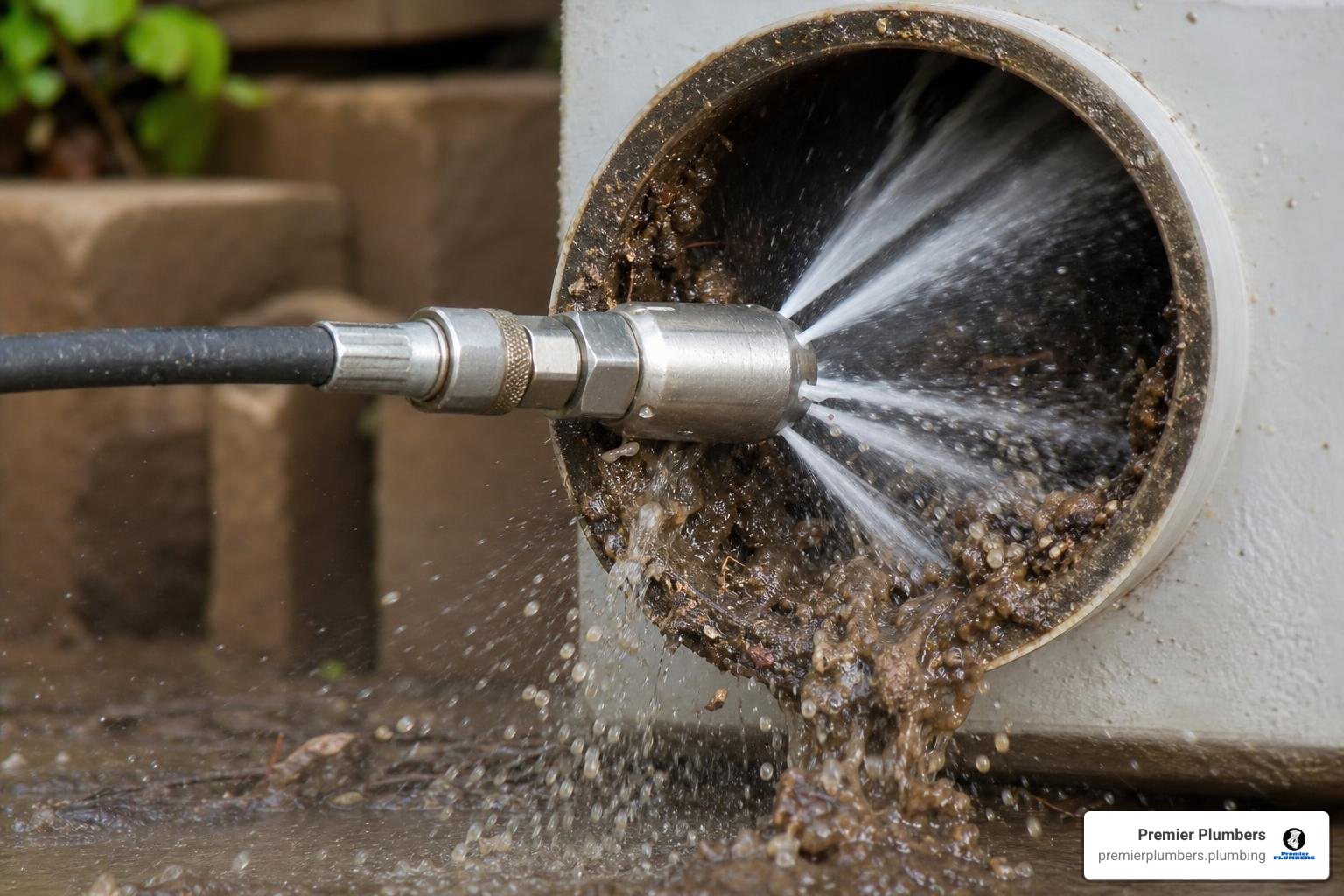
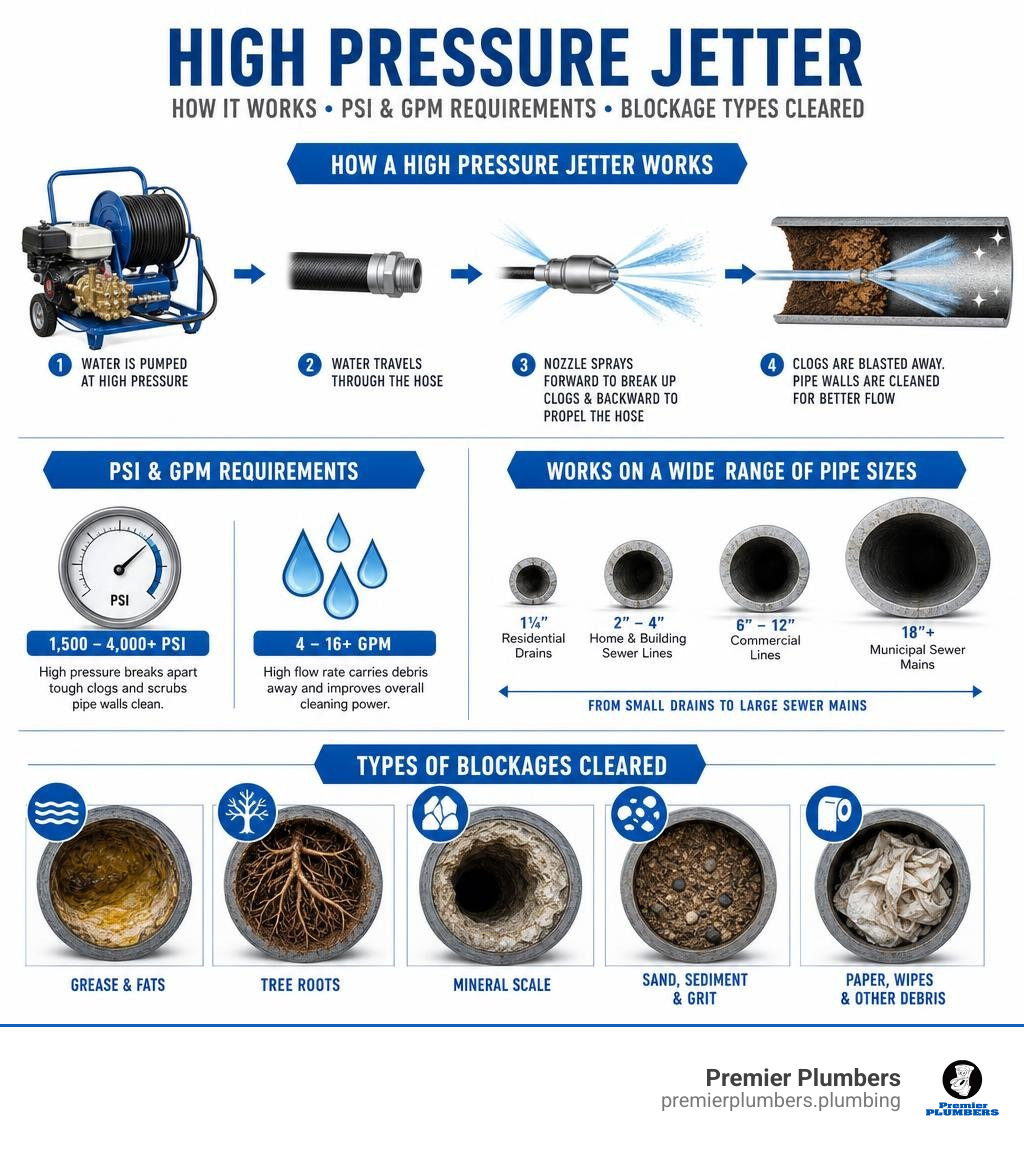
To understand why a high pressure jetter is so effective, you have to look at the physics of water under pressure. Unlike a mechanical drain snake that uses a metal cable to punch a hole through a clog, a hydro jetter uses pure water pressure and high flow rates to completely scour the inside of a pipe.
The system relies on a high-pressure pump, a specialized hose designed to withstand immense pressure, and a custom-engineered nozzle. When the machine is turned on, the pump forces water through the hose at incredible speeds. The magic happens at the nozzle, which features a series of precisely drilled rear-facing and forward-facing nozzle inserts.
The rear-facing water jets serve two critical purposes. First, they create a powerful forward propulsion that pulls the hose deep into the sewer line without the operator having to manually force it. Second, these rear jets act as a high-velocity broom, flushing debris downstream and out of the pipe. Meanwhile, the forward-facing jets act like a battering ram, cutting through grease, roots, scale, and solid blockages ahead of the hose.
By working the hose back and forth systematically, we can ensure that the pipe walls are thoroughly scrubbed. This process removes years of accumulated sludge and restores the line to its original carrying capacity. To learn more about this process, you can read our guide on how sewer jetting keeps your pipes screaming clean.

Choosing the Right High Pressure Jetter for Residential vs. Commercial Use
When it comes to hydro jetting, one size definitely does not fit all. The equipment we use for residential lines is vastly different from the heavy-duty machinery required for commercial mains and municipal culverts.
For smaller residential drains, which typically range from 1.5 inches to 4 inches in diameter, a compact electric or small gas-powered jetter is ideal. These units are highly portable, allowing technicians to maneuver them through tight spaces, residential hallways, and onto rooftops to access vent stacks. A perfect example of an indoor residential workhorse is the RIDGID KJ-1750 electric water jetter, which delivers a working pressure of 1,750 PSI and a flow rate of 1.4 GPM, making it highly effective for clearing kitchen grease, soap scum, and hair from lines up to 4 inches without risking damage to older home plumbing.
On the other end of the spectrum, commercial mains, restaurants, and municipal lines require serious muscle. Commercial pipes deal with heavy grease loads, massive root intrusions, and large debris. For these jobs, we utilize trailer-mounted or truck-mounted units that deliver massive flow rates and high pressures.
For heavy-duty industrial applications, equipment like the DYNAJET 500th high-pressure cleaner offers up to 7,250 PSI (500 bar) with a flow rate of 7.94 GPM. Some heavy industrial plunger pumps, such as the PressureJet KDD series, can deliver up to 7,250 PSI with flow rates up to 29.3 GPM, requiring up to a 120 HP motor. There are even ultra-high-pressure systems like the 130 Series Electric UHP Hydroblaster, which blasts water at an astonishing 20,000 PSI and 11.9 GPM to strip industrial coatings and clear municipal culverts. Choosing the right machine for our professional drain cleaning service ensures we clear the line safely and efficiently without compromising the pipe’s structural integrity.
Matching PSI and GPM to Tough Pipe Blockages
One of the most common misconceptions about hydro jetting is that higher pressure (PSI) is always better. In reality, water flow rate, measured in Gallons Per Minute (GPM), is often the more critical factor for successful drain cleaning. While PSI is the force that breaks the bond of the debris or cuts through tough obstructions, GPM is the vehicle that flushes the loosened debris out of the pipe. Without adequate flow, you will simply drill a small hole through the blockage, only for it to close back up once the tool is removed.
To help visualize how we match our equipment to different plumbing challenges, here is a breakdown of the required specifications for common blockages:
| Blockage Type | Recommended PSI | Recommended GPM | Best Nozzle Type | Key Action |
|---|---|---|---|---|
| Grease & Sludge | 2,000 to 3,000 | 12 to 18+ | Penetrating & Flushing | Cuts and emulsifies grease into tiny pieces |
| Tree Roots | 4,000 | 12+ | Rotary Root-Cutter | Slices through fibrous root masses at the pipe joints |
| Scale & Mineral Deposits | 4,000+ | 14 to 18 | Descaling / Rotating | Knocks hard scale off cast iron or clay walls |
| Large Rocks & Heavy Debris | 2,000+ | 25+ | High-Flow Flushing | Uses massive volume to push heavy solids downstream |
Understanding these requirements is essential for diagnosing when your plumbing system needs professional intervention. For a deeper look at the signs that indicate your pipes are facing these severe blockages, check out our article on signs your drains need more than a plunger.
The Industry Standard: Why the 4000 PSI at 18 GPM Configuration Rules
In the professional drain cleaning industry, there is one configuration that stands out as the ultimate versatile workhorse: the 4,000 PSI at 18 GPM hydro jetter.
This specific combination of high pressure and high volume is considered the gold standard because of its incredible range. It provides enough cutting power (4,000 PSI) to slice through thick tree roots and hardened scale, while delivering more than enough flushing action (18 GPM) to wash heavy sand, rocks, and thick grease out of the line.
A 4,000 PSI at 18 GPM unit is incredibly versatile, capable of cleaning pipes from small 4-inch residential sewer lines all the way up to 18-inch municipal culverts. It allows professional plumbers to tackle almost any residential or commercial job with a single, highly efficient machine, reducing setup times and ensuring a thorough clean every single time.
Cold-Water vs. Hot-Water Jetting: The Grease Debate
When it comes to clearing heavy grease and fat accumulations, particularly in commercial kitchens and restaurants, there is an ongoing debate in the plumbing world: is cold-water jetting or hot-water jetting better?
At first glance, hot-water jetting seems like the obvious choice. After all, when you wash greasy dishes in your sink, you use hot water to melt the grease. Machines like the HotJet II Ultra High Output Sewer Jetter, which delivers 12 GPM at 4,000 PSI powered by a 38 HP Kohler fuel-injected engine, are designed to heat water to melt grease and de-ice frozen lines quickly.
However, hot-water jetting has a major structural drawback when it comes to sewer lines. When hot water melts grease inside a pipe, that liquefied grease travels further down the line. As it moves away from the heated nozzle and encounters the cold underground pipe walls, the water cools down, causing the grease to solidify once again. This often creates a much larger, more compact blockage deeper in the sewer system or even in the municipal main, which can lead to severe city-wide backups. Additionally, hot-water jetting units require expensive diesel or oil burners, which increases operating costs, maintenance complexity, and fuel consumption.
Cold-water jetting, on the other hand, relies on mechanical cutting power. Instead of melting the grease, the high-pressure cold water slices the grease into tiny, solid fragments. Because these fragments remain solid, they do not stick together or coat the pipe further down. Instead, they are easily swept away by the high-flow GPM and flushed completely out of the system. Cold-water jetters are simpler, more reliable, and highly effective at permanently removing grease without the risk of downstream re-solidification. For smaller indoor grease lines, checking the electric water jetter specifications of compact cold-water units will show you just how efficient these smaller, cleaner machines can be for indoor commercial and residential applications.
Engineering a DIY Sewer Jetter: Pump and Engine Selection
For the mechanically inclined DIYer or the plumber looking to assemble a custom rig, building a sewer jetter can be a highly rewarding project. However, successful engineering requires a firm understanding of the physics and mathematics behind pump and engine selection. You cannot simply slap a massive pump onto a small engine and expect it to work.
The fundamental mathematical formula to determine the required horsepower (HP) for a high-pressure pump is:
Horsepower (HP) = (PSI x GPM) / 1,100
Let’s look at a practical example. If you want to build a jetter that delivers 3,500 PSI at 8 GPM, you can calculate the required horsepower as follows:
HP = (3,500 x 8) / 1,100
HP = 28,000 / 1,100
HP = 25.45
This means you need approximately 25.4 horsepower to run this setup efficiently.
A common mistake in the field is pairing an 8 GPM pump with a standard Honda GX 690 engine. While the GX 690 is an exceptional, top-of-the-line engine, it is rated at approximately 22 horsepower. If you attempt to run an 8 GPM pump at 3,500 PSI with this engine, you will overload it, causing it to stall or wear out prematurely. In the real world, a GX 690 setup will top out at around 3,200 PSI at the pump to maintain a reliable 8 GPM flow rate. When engineering a build, always calculate your horsepower requirements first, and remember that diesel engines typically require about 20% more horsepower than electric motors to achieve the same performance due to differences in torque curves and mechanical efficiency.
Converting a Standard Pressure Washer into a High Pressure Jetter
If you already own a high-quality commercial pressure washer, you might be tempted to convert it into a sewer jetter using an aftermarket conversion kit. While this is entirely possible and can be a cost-effective solution for light residential clogs, there are several critical considerations to keep in mind.
First, you must select the correct hose diameter. If you are cleaning small 2-inch to 3-inch lines, a 1/4-inch Inner Diameter (ID) hose is highly recommended. A 1/4-inch hose typically carries 2.5 to 3 GPM and is flexible enough to navigate tight elbows and sink traps without getting stuck. For larger 4-inch to 8-inch lines, you should step up to a 3/8-inch ID hose, which can handle higher flow rates of around 3.5 GPM and offers less pressure loss over long distances.
Second, never use quick-connect fittings on any part of the hose or nozzle that will enter the pipe. Quick-connects are highly prone to catching on pipe joints or offsets. If a quick-connect sleeve is bumped underground, it can release the nozzle, leaving your expensive tool trapped inside the sewer line. Always thread your nozzles directly onto the hose using high-strength thread locker.
Finally, consider adding a pulse valve to your pump. A pulse valve temporarily disables one of the pump’s check valves, causing the pump to run unevenly (similar to a car engine running on three cylinders). This creates a rapid vibration or hammering effect in the hose, which helps it wiggle through tight bends and slide past obstacles. However, use this feature sparingly, as prolonged pulsation causes pump cavitation and severe mechanical stress on your equipment.
Essential Nozzles, Hoses, and Accessories for Hydro Jetting
The pump and engine create the power, but the nozzle is what actually does the work. Having the right nozzle for the job is the difference between a cleared line and a wasted afternoon.
There are several essential nozzle types that every professional plumber carries:
- Penetrating Nozzles: These feature a single, highly focused forward-facing jet and three or four rear jets. They are designed to blast a hole through solid blockages like ice, hard grease, or packed dirt.
- Spinning/Rotary Nozzles: These use rotating water jets to provide complete 360-degree wall-to-wall cleaning. They are highly effective at stripping grease, scale, and fine root systems.
- Drop Head Nozzles: Designed with a hinged or flexible joint, these help guide the hose around sharp 90-degree elbows and complex residential traps.

Beyond nozzles, having the right hose and safety accessories is paramount. High-pressure hoses must be constructed from durable materials like thermoplastic or braided steel to resist abrasion from rough pipe walls. It is also important to account for pressure drop; as water travels through a long, narrow hose, friction reduces the pressure delivered at the nozzle. For industrial applications, integrating a high-pressure water jet cleaning system with safety features like a foot-operated control valve is essential, as it allows the operator to instantly cut off water flow if a safety hazard arises.
Before we ever insert a jetter into a pipe, we always recommend conducting a thorough visual inspection. Utilizing professional video sewer inspections allows us to locate the exact position and nature of the clog, inspect the structural health of the pipe, and select the perfect nozzle configuration for the job.
Safety Protocols and Maintenance for High-Pressure Equipment
Operating a high pressure jetter is highly effective, but it is not a game. Water pressurized to 4,000 PSI or higher carries enough kinetic energy to cut through wood, concrete, and unfortunately, human flesh. Skin contact with a high-pressure water stream can cause severe injection injuries, where water and bacteria are forced deep into body tissues, leading to rapid infection and potential amputation.
To keep our technicians and customers safe, the Premier Plumbers team follows strict safety protocols:
- Always Wear Proper PPE: This includes heavy-duty safety goggles, face shields, specialized water-resistant gloves, and high-pressure safety boots.
- Use a Safety Leader: A safety leader is a brightly colored section of hose (usually red or orange) placed right before the nozzle. This provides a visual warning to the operator that the highly dangerous nozzle is approaching the pipe opening.
- Monitor the Water Tank: High-pressure pumps rely on water for cooling and lubrication. Running a pump dry, even for a few seconds, can destroy the pump seals and pistons. Always use a low-level water monitor to shut down the system automatically if water levels drop.
- Inspect Hoses Daily: Check hoses for kinks, outer cover wear, or exposed braiding. A damaged hose can burst under pressure, creating a massive safety hazard.
- Winterize the System: While we enjoy warm weather in Southwest Florida, if equipment is stored or transported through freezing temperatures, any water left inside the pump can freeze, expand, and crack the brass pump manifold. Always run non-toxic RV antifreeze through the system before storing it in cold conditions.
Frequently Asked Questions about Hydro Jetting
Can hydro jetting damage older clay or cast iron pipes?
Yes, if performed by an inexperienced operator using incorrect pressure settings. Older clay pipes can become fragile over time, and cast iron pipes can develop thin walls due to corrosion. An experienced plumber will always perform a camera inspection first to assess the pipe’s condition and adjust the jetter’s PSI to a safe level to clear the clog without causing structural damage.
How often should commercial grease lines be hydro jetted?
For commercial kitchens and busy restaurants, we generally recommend preventative hydro jetting every 3 to 6 months. High-volume kitchens accumulate grease rapidly, and waiting for a backup to occur can result in costly emergency plumbing repairs and lost business revenue due to temporary closures.
Why is water flow rate (GPM) sometimes more important than pressure (PSI)?
Pressure (PSI) is the cutting force that breaks up a clog, but water flow (GPM) is what actually carries the debris out of the plumbing system. If you use high pressure with very low flow, you will simply drill a small hole through the blockage, and the debris will remain in the pipe, leading to another clog shortly after. High GPM ensures the pipe is completely flushed clean.
Conclusion
When you are dealing with a stubborn main sewer line backup or a recurring kitchen clog, traditional drain cleaning methods often fall short. Investing in professional hydro jetting is the fastest, most effective, and most environmentally friendly way to restore your plumbing system to peak performance.
At Premier Plumbers, we bring a three-generation legacy of plumbing expertise and quality to every single job. Our team is fully equipped with state-of-the-art high-pressure jetting equipment to handle the unique plumbing challenges faced by Florida homeowners, from sandy soil blockages to invasive palm and live oak root systems. Whether you are in Sarasota, Bradenton, Fort Myers, Tampa, or Naples, you can count on us for reliable, professional service. If your drains are running slow or backing up, do not wait for a major emergency to strike; contact our professional hydro jetting technicians today to schedule an inspection and get your pipes flowing freely again.