Plumber vs. Plumbing Contractor: Understanding the Key Differences
A plumbing contractor is a licensed business entity that manages plumbing projects from start to finish, including hiring certified plumbers, pulling permits, and ensuring all work meets local building codes. Here is a quick overview of what sets a plumbing contractor apart:
- Licensed to bid and manage jobs: Only licensed plumbing contractors can legally advertise, bid on, and perform plumbing work in most states.
- Employs certified plumbers: Contractors hire and supervise journeyman and apprentice plumbers on-site.
- Handles complex projects: Water mains, sewer systems, gas lines, and new construction go beyond what a standard plumber does.
- Carries insurance and bonding: Contractors must hold liability insurance, a surety bond, and workers’ compensation coverage.
- Responsible for permits and code compliance: The contractor, not the individual plumber, is legally accountable for proper permits and inspections.
Choosing the wrong person for the job can mean failed inspections, voided warranties, or costly rework. This checklist will help you hire the right professional with confidence.
Not every plumbing problem needs a full contractor. But when the work involves new construction, major renovations, or whole-system replacements, a licensed plumbing contractor is the only legal and safe choice. In states like Washington, you cannot even advertise plumbing services without a contractor license.
At Premier Plumbers, we are a team of third-generation plumbing contractors with over 34 years of hands-on experience serving homeowners and businesses throughout Southwest Florida. Our team offers honest, expert guidance for homeowners planning repairs, replacements, renovations, and larger plumbing projects.
When you have a plumbing issue, you might think any plumber can handle the job. However, there is a distinct hierarchy and structural difference between an individual plumber and a licensed plumbing contractor. Understanding these differences ensures you hire the right professional for your specific project scale and avoids potential legal or structural issues.
Standard plumbers are typically trade professionals who carry out daily hands-on tasks, often working as employees for a larger contracting business. A plumbing contractor, on the other hand, is a fully registered business entity. The contractor holds the ultimate legal and financial responsibility for the work, manages the project from design to completion, and has the authority to pull municipal permits.

Scope of Work for a Standard Plumber
An individual plumber is highly skilled at executing everyday repairs and fixture installations. If your home has a clogged toilet, a dripping faucet, or a broken garbage disposal, a standard plumber is the perfect professional for the job.
Their typical scope of work includes:
- Fixing minor leaks and clearing local clogs.
- Performing routine drain cleaning to restore proper sink and shower flow.
- Installing household fixtures like sinks, faucets, toilets, and showers.
- Conducting standard plumbing repairs on existing, easily accessible lines.
While these tasks are vital for keeping your home running smoothly, standard plumbers generally do not handle major structural changes, nor do they typically bid on large-scale commercial or new construction projects.
Advanced Capabilities of a Licensed Plumbing Contractor
A licensed plumbing contractor possesses advanced capabilities and legal authorizations that go far beyond standard maintenance. Contractors are trained to design, install, and oversee entire plumbing infrastructures for residential and commercial buildings.
Their specialized capabilities include:
- Planning and executing whole-home repiping to replace outdated or corroded copper and galvanized pipes.
- Installing and repairing main water lines, complex sewer systems, and septic networks.
- Performing complete sewer replacement using advanced excavation or trenchless technologies.
- Designing and installing gas lines and high-capacity commercial water heating systems.
- Coordinating directly with local building departments to secure permits and pass mandatory code inspections.
If your project involves structural modifications, new additions, or commercial spaces, you must hire a licensed contractor to ensure the work is legally compliant and structurally sound.
Licensing, Insurance, and Legal Obligations for Contractors
Operating as a plumbing contractor requires meeting strict legal, financial, and educational standards. These regulations exist to protect property owners from subpar workmanship, structural damage, and financial liability. Licensing boards enforce these rules to maintain safety across the industry.
| Requirement Type | Standard Plumber | Licensed Plumbing Contractor |
|---|---|---|
| Licensing Level | Journeyman or Master Plumber license | Business entity contractor license |
| Bonding | Not typically required individually | $25,000 surety bond (varies by state) |
| Liability Insurance | Covered under employer policy | General liability and property damage |
| Permit Authority | Cannot pull municipal permits | Authorized to pull all plumbing permits |
| Supervision Duty | Performs hands-on trade work | Responsible for supervising all field staff |
Plumbing Contractor Regulations in Washington, Minnesota, and Colorado
Licensing paths vary significantly across different states. For example, in Washington state, the Department of Labor and Industries (L&I) mandates that only licensed plumbing contractors may advertise, bid on, or perform plumbing work. These contractors must designate a certified plumber to oversee all operations.
In Minnesota, the Department of Labor and Industry (DLI) requires contractors to post a $25,000 surety bond, maintain active public liability insurance, and pay an initial application fee. Colorado regulates its professionals through the Colorado State Plumbing Board, which focuses heavily on direct inspections and compliance with national plumbing codes.
For local Florida projects, property owners can verify active licenses through official county contractor directories to confirm that a plumbing contractor is registered to work in the appropriate municipality.
Residential vs. Commercial Licensing Differences
The technical demands of residential plumbing differ greatly from commercial systems. Consequently, licensing requirements often reflect these differences. Residential work typically deals with lower water pressure, standard gravity-fed drainage, and simpler fixture layouts.
Commercial plumbing contractors must design systems that handle massive daily usage, high-pressure water mains, and complex backflow prevention. They must also ensure strict compliance with the Americans with Disabilities Act (ADA) for public restrooms and commercial facilities. To verify that your project complies with local municipal rules, contractors must obtain specific authorizations, such as the required plumbing permits in Collier County.
Bonding, Liability Insurance, and Workers’ Compensation
A reputable plumbing contractor must carry extensive financial protections. These safeguards protect your property from accidents and financial disputes during construction.
- Surety Bonds: Many states require a $25,000 surety bond. This bond acts as a financial guarantee that the contractor will complete the project according to local laws and contract terms.
- Liability Insurance: Contractors must carry public liability insurance, often with minimum limits of $50,000 per person and $100,000 per occurrence, plus property damage coverage, to cover accidental damage to your home or business.
- Workers’ Compensation: This coverage is non-negotiable. It ensures that if an employee is injured on your property, the contractor’s insurance covers their medical expenses and lost wages, protecting you from personal injury lawsuits.
Permits, Code Compliance, and Employee Supervision
A licensed contractor is legally responsible for everything that happens on a job site. This includes providing direct, physical supervision of all apprentices and unlicensed employees. Electronic or remote supervision is not legally sufficient; a certified supervisor must regularly inspect the physical work to ensure it aligns with local building codes.
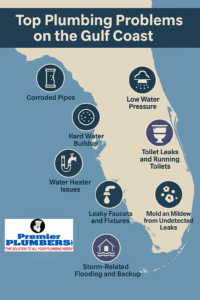
Securing the proper permits before starting work is a legal necessity. Failing to pull permits can result in heavy municipal fines, delayed real estate transactions, and a complete lack of insurance coverage if a system fails. Proper documentation and strict code compliance are particularly crucial when addressing common plumbing problems on the Gulf Coast, where unique environmental factors, shifting soils, and high humidity levels demand specialized installation techniques.
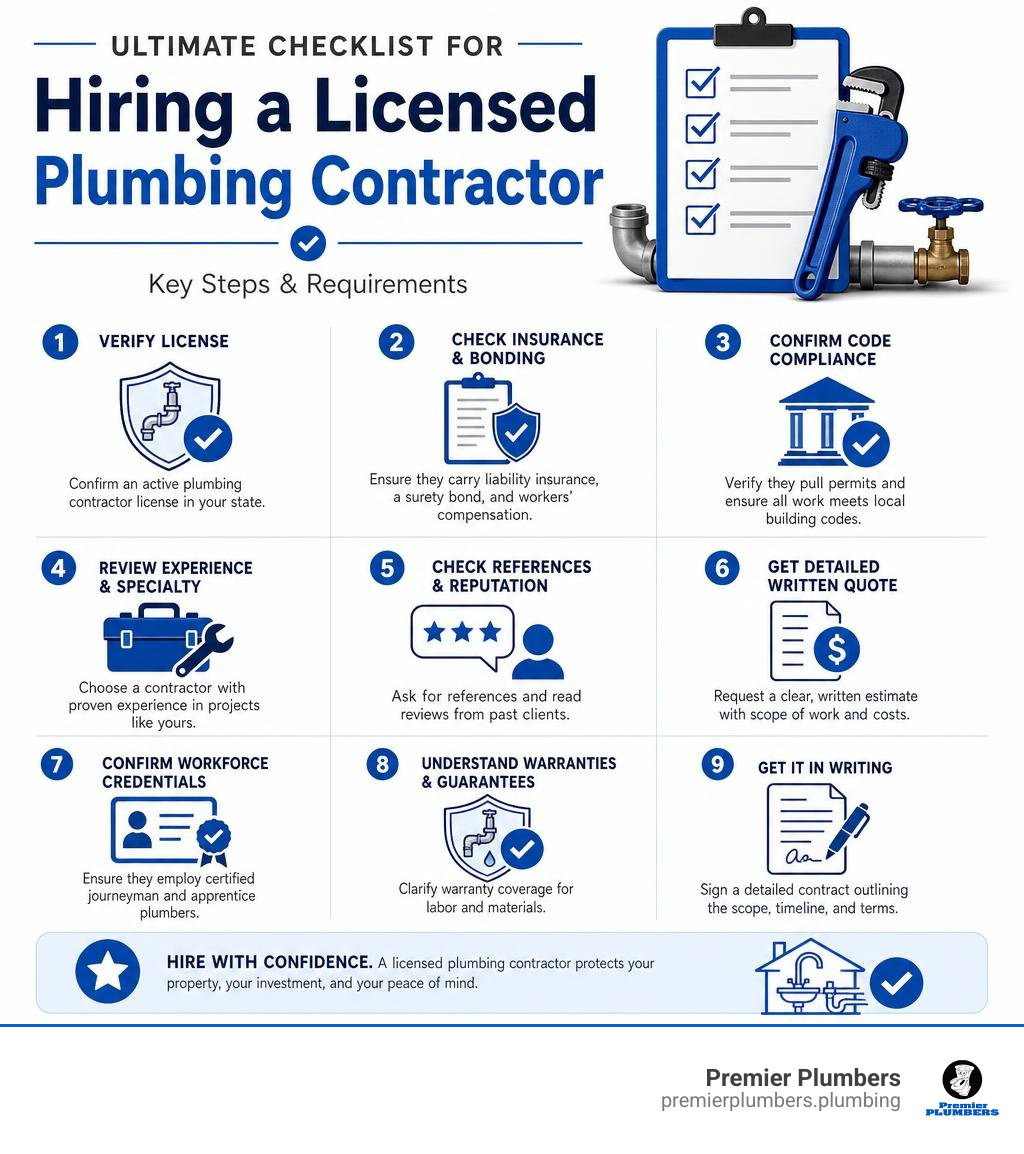
Ultimate Checklist for Hiring a Professional Plumbing Contractor
Hiring a contractor is a decision that impacts your home’s safety, your project’s budget, and your overall peace of mind. Taking the time to verify credentials before signing a contract will save you from stress, delays, and unexpected costs down the road.
Verifying Licenses, Insurance, and Credentials
Before you hire any company, run through this verification checklist:
- Request the license number: Every legitimate contractor will gladly provide their state and local license numbers.
- Search state databases: Verify the license status on your state’s licensing portal to ensure it is active and free of unresolved complaints.
- Ask for insurance certificates: Request proof of general liability and workers’ compensation insurance sent directly from the contractor’s insurance agency.
- Compare regional experience: Look for established local businesses that understand local soil, water chemistry, and municipal codes in Sarasota, Fort Myers, Naples, Tampa, Bradenton, Charlotte County, Collier County, and Lee County.
- Verify reputation across multiple platforms: Read recent customer feedback and look for consistent comments about communication, punctuality, workmanship, and cleanup.
- Ask about code-specific expertise: Confirm that the contractor regularly handles inspections, permit requirements, and project types similar to yours.
For repairs and maintenance, a contractor with everyday service experience can help you avoid turning a small issue into a major project. Premier Plumbers supports homeowners with drain cleaning for slow or blocked drains and plumbing repairs for leaks, fixture problems, and other common household issues.
For larger projects, it helps to work with a team that can diagnose system-wide problems and recommend the right long-term fix. If your home has aging pipes, repeated leaks, or recurring sewer issues, Premier Plumbers can evaluate whether whole home repiping or sewer replacement is the safest option.
Regional experience matters because Gulf Coast plumbing systems face humidity, shifting soils, mineral-heavy water, storms, and other conditions that can shorten the life of pipes and fixtures.
Collaboration with General Contractors and Construction Firms
On major remodeling or new construction projects, a plumbing contractor does not work in isolation. They must collaborate closely with general contractors, architects, and other trade professionals like HVAC and electrical teams.
This collaboration involves:
- The Bidding Process: Providing accurate, detailed estimates based on architectural blueprints.
- Scheduling: Coordinating the “rough-in” phase before drywall is installed, and the “trim-out” phase after walls and cabinets are completed.
- Project Management: Ensuring the plumbing installation does not interfere with HVAC ductwork, structural framing, or electrical wiring.
When everyone communicates effectively, the project stays on schedule, stays within budget, and passes structural inspections without a hitch.
Frequently Asked Questions about Plumbing Contractors
What is the difference between a master plumber and a plumbing contractor?
A master plumber is an individual who has reached the highest level of personal trade certification through years of experience, classroom education, and passing rigorous state exams. A plumbing contractor is a registered business entity. While a plumbing contractor business must employ or be owned by a master plumber to operate legally, the contractor license itself is what allows the business to bid on commercial projects, hire employees, pull permits, and carry commercial liability insurance.
Can a general contractor perform plumbing work without a plumbing license?
No, general contractors cannot perform plumbing work themselves unless they also hold a separate, active plumbing contractor license. Under state regulations, general construction firms must hire licensed plumbing subcontractors to handle any pipe installations, sewer connections, or water line modifications on their job sites.
How often do plumbing contractor licenses expire?
License renewal cycles vary by state and local municipality. In many states, contractor licenses expire on December 31 of odd-numbered years and require proof of continuing education, active liability insurance, and updated surety bonds to remain active. It is always wise to verify that your contractor’s license is current before starting any major project.
Conclusion
Finding the right plumbing contractor does not have to be an overwhelming process. By verifying licenses, checking insurance coverage, and understanding the differences between a standard plumber and a full-service contractor, you can protect your property and ensure your project is completed safely and legally.
At Premier Plumbers, we bring a proud, three-generation family legacy of plumbing expertise directly to your doorstep. We are committed to providing transparent communication, top-quality materials, and reliable service for every project, large or small. When you are ready to plan your next residential or commercial plumbing project, contact our professional plumbing specialists to schedule an inspection and get a detailed, upfront estimate from our experienced team.