
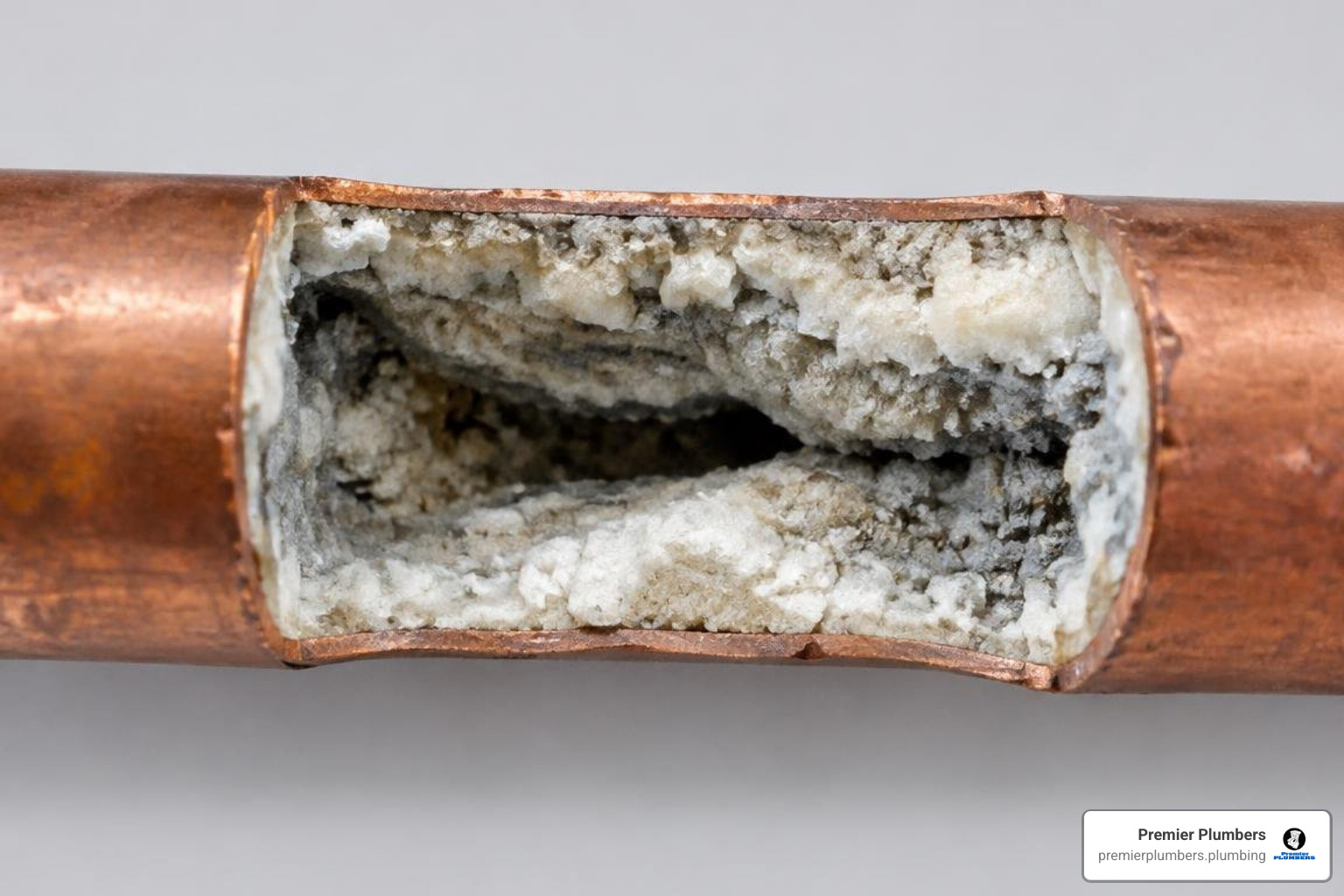
What Causes Hard Water and How to Spot the Signs in Your Home
Hard water develops naturally as groundwater filters through rich underground deposits of limestone, chalk, and gypsum. As water travels through these mineral beds, it dissolves trace amounts of calcium and magnesium. While these minerals are completely safe to drink, they create continuous challenges once they enter your home plumbing system.
When hard water heats up or evaporates, the dissolved minerals solidify into a crusty, chalky substance known as limescale. This buildup does not simply stay on the surface of your sink. Over time, it coats the interior of your copper or PEX pipes, narrows water passages, restricts water pressure, and forces major appliances to work much harder. For a broader scientific overview, the United States Geological Survey explains how water hardness is measured and mapped across the country.
Understanding how treatment methods work can make it easier to protect your plumbing and appliances. Our guide to water purification explains how different treatment approaches can address common household water-quality concerns.
You can easily identify hard water problems throughout your home by watching for these telltale indicators:
- Thick limescale deposits: Crusty white or greenish buildup coating showerheads, sink aerators, and faucet bases.
- Persistent soap scum: A stubborn film clinging to bathtub walls, tile grout, and glass shower enclosures that resists ordinary bathroom cleaners.
- Dull, scratchy laundry: Towels that feel stiff and cardboard-like, along with colored fabrics that fade prematurely due to trapped mineral particles.
- Dry skin and brittle hair: Bath water that leaves your skin feeling tight, itchy, and irritated, while stripping natural moisture from your hair.
- Cloudy glassware and dishes: Dishes, drinking glasses, and silverware emerging from the dishwasher covered in milky streaks and water spots.
- Water heater strain: Rumbling or popping noises coming from your water heater tank as heating elements struggle against a thick blanket of bottom sediment.
How a Water Softener Works to Protect Your Plumbing and Appliances
A whole-house water softener resolves hard water issues through a well-established scientific process called ion exchange. The system consists of two primary components: a tall resin tank filled with thousands of tiny, negatively charged polystyrene resin beads, and a separate brine tank containing dissolved salt.
As hard water enters your home, it flows directly into the resin tank. The dissolved calcium and magnesium ions carry a positive electrical charge that is stronger than the mild charge of the sodium ions coating the resin beads. As the water passes through the bed, the resin attracts and traps the hardness minerals, releasing an equal balance of sodium ions into the water supply in their place. The water leaving the tank is fully softened and flows smoothly through your plumbing fixtures without forming scale.
Over several days of continuous treatment, the resin beads become saturated with captured calcium and magnesium. To restore performance, the system enters a regeneration cycle. The control valve draws concentrated salt water from the brine tank and flushes it across the resin bed. The high concentration of sodium frees the trapped minerals, washing them down the drain line before rinsing the resin clean for another cycle.
For a whole-home solution tailored to your water conditions, Premier Plumbers provides water purification services that can help determine whether a softener, filtration system, or combined approach is appropriate.
Softening your water safeguards appliances from premature breakdown. Water heaters operating on soft water maintain factory efficiency, potentially lowering water heating energy consumption by up to 30%.
For households considering drinking-water treatment alongside softening, our explanation of reverse osmosis water filters outlines how this technology can support cleaner water at dedicated taps.
Salt-Based vs. Salt-Free Water Softener Systems
When researching water treatment, homeowners frequently encounter both traditional salt-based softeners and salt-free water conditioners. While both systems protect your plumbing, they operate on completely different mechanical principles.
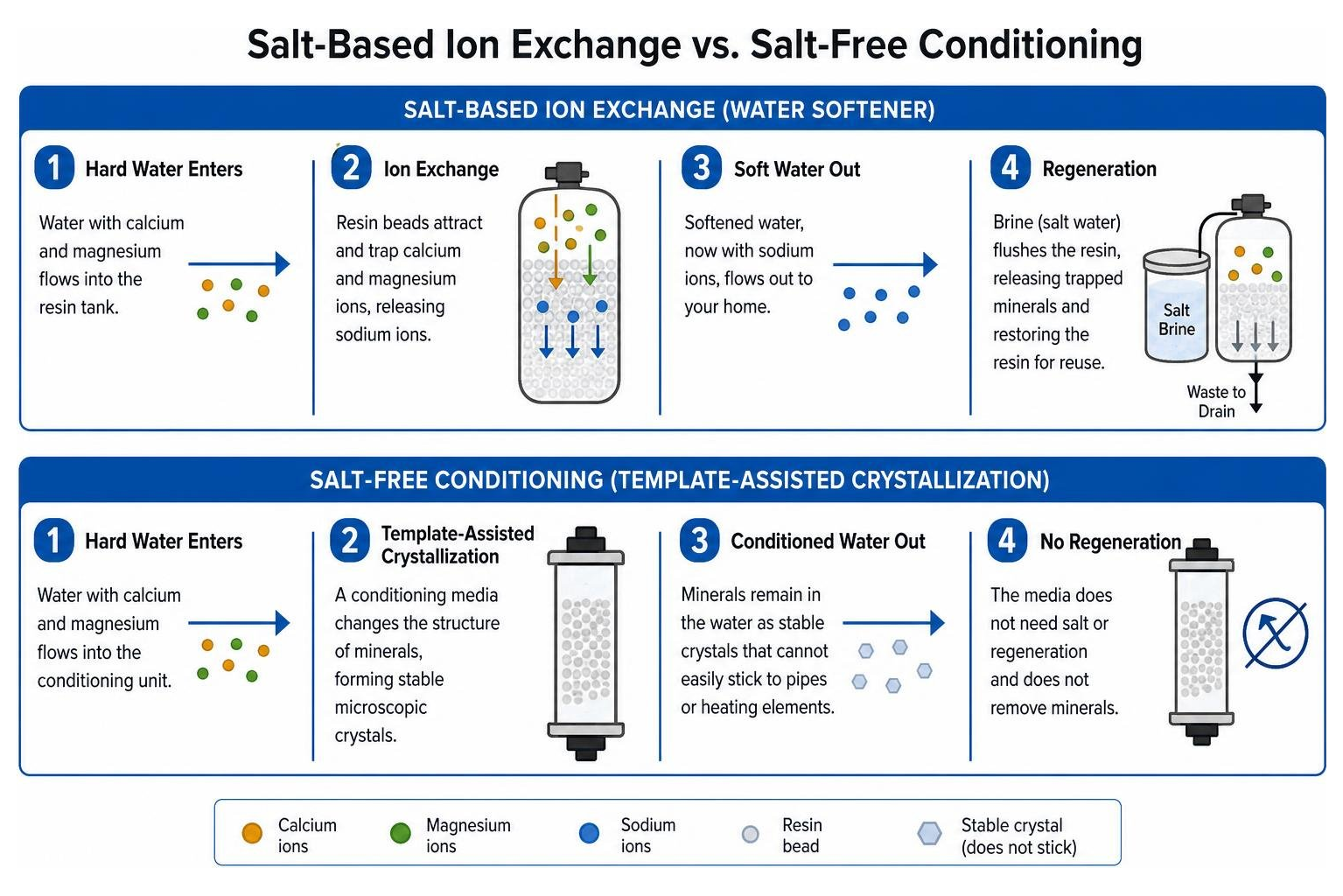
A traditional salt-based system uses sodium chloride or potassium chloride to extract hardness minerals entirely from your water supply. This provides true soft water, eliminating soap scum, leaving laundry plush, and keeping glassware spotless.
In contrast, salt-free water conditioners utilize a physical process called Template-Assisted Crystallization (TAC). These systems do not remove calcium or magnesium. Instead, they alter the physical structure of the minerals, transforming them into microscopic crystals that cannot easily adhere to pipe walls or heating elements.
| Feature | Salt-Based Water Softener | Salt-Free Water Conditioner |
|---|---|---|
| Primary mechanism | Ion exchange (replaces hardness with sodium) | Template-Assisted Crystallization (neutralizes scale) |
| Mineral removal | Completely removes calcium and magnesium | Leaves minerals in the water |
| Lathering and soap use | Significantly improves soap lather and cuts soap use | Little to no change in soap efficiency |
| Skin and hair feel | Leaves skin smooth and hair soft | Water feels identical to untreated hard water |
| Wastewater and electricity | Requires regular drain discharge and power | Zero wastewater and no electricity required |
| Maintenance demands | Regular salt additions to brine tank | Annual or semi-annual filter media replacement |
Upflow vs. Downflow Regeneration Cycles
The internal engineering of your softening unit plays a significant role in long-term efficiency. Traditional downflow systems direct incoming brine water downward through the top of the resin tank. While functional, this method pushes accumulated minerals down through previously cleaned resin, requiring larger volumes of water and salt to complete a full recharge.
Modern high-efficiency systems feature upflow regeneration, also known as counter-current brining. In an upflow water softener cabinet, the brine solution enters from the bottom of the tank and travels upward. This design targets the most exhausted resin beads first while preserving unused resin at the top. When paired with demand-initiated regeneration, which monitors daily water consumption rather than running on a fixed timer, upflow systems can use up to 75% less salt and 64% less water than older models.
How to Size, Install, and Maintain Your System
Selecting the proper unit requires matching the grain capacity of the system to your family’s daily water usage and local hardness levels. A system that is too small will regenerate too frequently, leading to excessive wear and wasted salt, while an oversized unit may lead to water channeling through unused resin beds.
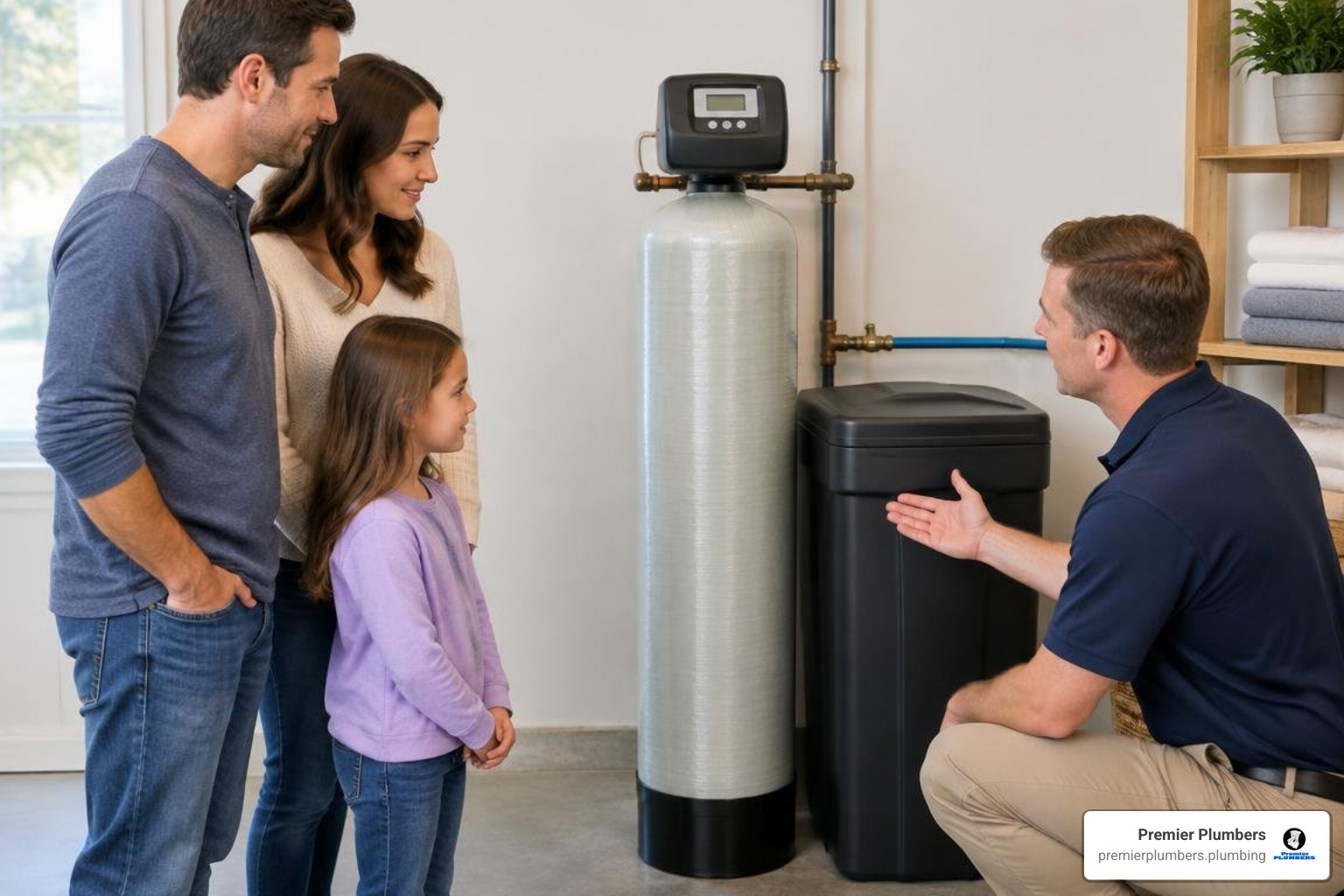
If you are upgrading your home mechanical systems, Premier Plumbers can help you coordinate the project with comprehensive plumbing services and calculate water-treatment requirements for reliable performance from day one.
Calculating Household Grain Capacity Requirements
Water hardness is measured in grains per gallon (GPG). To calculate the ideal capacity for your home, multiply the number of people living in your household by the standard average daily consumption of 75 gallons per person. Next, multiply that daily water volume by your home’s water hardness level (in GPG) to determine your daily grain removal requirement. Finally, multiply that daily figure by 7 to account for a standard weekly regeneration frequency.
$$text{Daily Grains} = (text{Household Members} times 75text{ Gallons}) times text{Hardness (GPG)}$$
$$text{System Capacity} = text{Daily Grains} times 7text{ Days}$$
Use these general capacity guidelines when evaluating standard system sizes:
- 32,000-grain capacity: Well suited for compact households with 1 to 2 bathrooms and up to 3 residents.
- 42,000- to 48,000-grain capacity: Ideal for mid-sized homes with 2 to 4 bathrooms and 3 to 5 occupants dealing with moderate to high hardness.
- 60,000- to 64,000-grain capacity: Designed for large households with 5 to 6 bathrooms, large families of 5 to 7 people, or homes experiencing severe hardness and high peak flow rates.
Step-by-Step Water Softener Maintenance Routine
Regular maintenance keeps your water treatment equipment operating smoothly and protects the internal resin bed for 10 to 15 years. Follow this practical care routine:
- Monthly salt inspections: Open the brine tank lid once a month to check the salt level. Keep the salt filled at least three to four inches above the standing water level, but avoid overfilling the tank to the very brim.
- Break up salt bridges: In humid climates, a hard crust of salt known as a salt bridge can form across the tank, leaving an empty air pocket above the water. Gently tap the sides or use a broom handle to break up any solid crusts so the salt drops freely into the brine.
- Clear salt mushing: Periodically inspect the bottom of the brine tank for salt mushing, which happens when dissolved salt recrystallizes into a thick sludge. If this occurs, clean the tank, drain the sludge, and refill it with fresh salt pellets.
- Clean the resin bed annually: Add an approved resin bed cleaner once or twice a year to strip away iron, silt, and heavy mineral coatings that normal salt brine cannot wash away.
- Inspect the bypass valve and drain lines: Check the bypass valve assembly and drain hose connections annually to confirm there are no leaks, kinks, or mineral obstructions hindering flow.
Frequently Asked Questions About Hard Water Solutions
How often do you need to add salt to the brine tank?
Most residential brine tanks hold between 175 and 200 pounds of salt pellets. For an average family of four, you will typically need to add one 40-pound bag of salt to the brine tank every four to six weeks. Salt consumption depends on your daily water usage, the hardness of your incoming supply, and how frequently your system initiates a regeneration cycle. Checking the tank level once a month ensures your system never runs dry.
Can softening systems remove iron and heavy metals?
Standard water softeners can remove moderate amounts of dissolved, clear-water iron (ferrous iron), typically up to 3 to 5 parts per million (ppm). Units built with specialized fine mesh resin are particularly effective at iron reduction.
However, softeners cannot easily remove oxidized red-water iron (ferric iron), organic iron, or heavy industrial contaminants. If your well water contains high levels of iron, sediment, or chlorine above 1 ppm, our team recommends installing a dedicated whole-home pre-filtration system to protect the softener resin from premature fouling.
What is the difference between a water softener and a water conditioner?
A water softener actively removes hardness minerals (calcium and magnesium) from your water through ion exchange, replacing them with sodium or potassium ions. This changes the chemical properties of the water, producing authentic soft water that enhances soap lather and eliminates scale.
A water conditioner does not remove minerals from the water. Instead, it alters their crystalline structure to reduce scale formation inside pipes without softening the water or changing its mineral composition.
Conclusion
Untreated hard water can quietly take a toll on your home plumbing, reduce the lifespan of expensive appliances, and leave behind stubborn limescale. Installing an appropriately sized softening system protects your plumbing infrastructure, lowers ongoing utility bills, and provides comfortable water for bathing and cleaning throughout your entire home.
At Premier Plumbers, our family-owned team brings three generations of hands-on plumbing expertise to every home we serve across Southwest Florida. Whether you need a comprehensive water hardness evaluation, professional installation of an energy-efficient system, or preventative plumbing care, contact our professional water purification specialists to schedule your home water assessment.