Warning Signs Indicating Your Plumbing System Needs Pipe Replacement
For older Southwest Florida homes, the primary pipe replacement options include modern PEX or copper for potable supply lines, Schedule 40 PVC for drain and vent systems, and trenchless HDPE or cured-in-place pipe lining for buried sewer laterals. Choosing the right approach starts with recognizing when your existing plumbing has reached the end of its service life.
Plumbing problems rarely start with a catastrophic flood. More often, they begin with subtle clues that are easy to dismiss until water begins dripping through a ceiling or bubbling up under a floor slab. In our decades of servicing coastal and inland properties, we find that catching these early warning signs can mean the difference between a planned, orderly plumbing upgrade and an emergency insurance claim.
Frequent leaks are the most obvious symptom. If you find yourself fixing multiple pinhole leaks in copper lines within a span of a few months, your piping system has likely reached the end of its lifespan. Pinhole leaks happen when water chemistry and internal wear thin out pipe walls until they fail under standard municipal water pressure.
Water discoloration is another telltale sign. When you turn on a faucet first thing in the morning and notice brown, yellow, or reddish water, you are looking at oxidized metal peeling away from the inside of your pipes. This rust is accompanied by a distinct metallic taste or unpleasant sulfur odors.
You should also keep an eye on water pressure fluctuations. When multiple fixtures run at the same time and your shower pressure drops to a trickle, interior mineral scaling or line restriction could be choking your supply. Outdoors, soft or perpetually wet patches on your lawn can point toward a subterranean break. Learning the primary underground water line repair signs helps prevent soil erosion, sinkholes, and structural foundation shifts.
Deteriorating Galvanized Steel and Cast Iron Infrastructure
Homes built before the mid-1970s across Southwest Florida often rely on galvanized steel for clean water lines and cast iron for waste systems. Galvanized steel pipes are coated in zinc to resist rust, but decades of exposure to minerals cause that protective layer to erode. As the bare iron underneath oxidizes, rust nodules form on the pipe interior. This scaling narrows the pipe’s internal diameter, drastically restricting water volume and eventually causing brittle fractures.
Cast iron drain lines face an equally harsh reality. While cast iron was long considered durable, it is highly susceptible to bottom-channel rot, hydrogen sulfide gas erosion, and tree root penetration. Over decades, acidic waste wears away the bottom of the horizontal pipe run, creating a flat trench where waste catches and creates chronic blockages.
When drain lines crack or collapse, sewage smells seep into living areas, toilets drain sluggishly, and wastewater can back up into tubs and showers. Homeowners can use this guidance on identifying failing cast iron pipes to recognize when corrosion has progressed past simple snaking or patching.
For a permanent solution to advanced corrosion, chronic backups, or failed cast iron drain lines, a cast iron pipe replacement in Southwest Florida restores sanitary, free-flowing drains.
Polybutylene Risks and Potable Water Leaks
If your home was constructed between the late 1970s and the mid-1990s, there is a strong chance your supply system uses polybutylene piping. Often identified by its dull gray appearance and plastic or metal insert fittings, polybutylene was marketed as an inexpensive alternative to copper.
Unfortunately, polybutylene reacts poorly to municipal water treatments. Chlorine and other disinfectants attack the acetal resin inside the plastic, making the material brittle, micro-fractured, and prone to sudden, catastrophic failure. Because these breaks often occur without warning at joints and bends behind walls, insurance carriers frequently exclude polybutylene from standard homeowner coverage or demand proof of repiping before issuing policies.
In homes with vintage plumbing systems, older pipe joints may also contain lead solder. Even minute levels of lead pose significant health risks, particularly for infants and young children. If your plumbing system includes aged, unknown materials, running a professional laboratory water test and using NSF-53 certified filtration units is a smart step while you plan your whole-home pipe replacement.
Comparing Supply and Drain Pipe Materials for Florida Homes
Selecting the correct piping material requires balancing performance, durability, ease of installation, and local environmental conditions. High humidity, sandy soils, and mineral content all affect how materials hold up over time.
| Pipe Material | Common Application | Durability & Lifespan | Pros | Cons / Vulnerabilities |
|---|---|---|---|---|
| PEX (Cross-linked Polyethylene) | Potable Water Supply | 40 to 50+ Years | Highly flexible, resists mineral scale, no soldered joints inside walls, cost-effective | Degrades under direct UV light, indoor use only |
| Copper (Type L / K) | Potable Water Supply & Mains | 30 to 50+ Years | Rigid, UV-resistant, natural biostatic qualities, time-tested | Vulnerable to pinhole leaks from acidic or hard water, higher material expense |
| CPVC (Chlorinated Polyvinyl Chloride) | Potable Water Supply | 20 to 30 Years | Corrosion-resistant, low initial material cost, simple solvent-weld assembly | Becomes brittle with age, sensitive to temperature shifts |
| PVC (Schedule 40) | Drain, Waste, & Vent (DWV) | 50 to 70+ Years | Smooth interior prevents clogs, completely rust-proof, budget-friendly | Not rated for high-temperature hot water distribution |
| HDPE (High-Density Polyethylene) | Sewer Laterals & Main Lines | 50 to 100 Years | Seamless heat-fused joints, root-proof, ideal for trenchless installation | Requires specialized fusion equipment for installation |
PEX vs Copper for Potable Pipe Replacement
When replacing potable water lines, the choice usually comes down to PEX or copper.
PEX has become the residential industry standard for indoor repiping. Its flexibility allows technicians to fish continuous lines through existing wall cavities and ceiling joists, requiring fewer drywall cutouts. Because PEX uses mechanical crimp or expansion fittings located primarily at accessible manifolds and fixture connections, there are virtually no hidden joints behind drywall that could leak later. PEX is also immune to the corrosion and scaling that plague metal pipes, and its slight elasticity makes it more resilient if unexpected freezing conditions occur.
Copper remains a premium, rigid piping option. Type L copper is sturdy, provides natural antimicrobial properties, and handles direct sunlight without degrading, making it well-suited for outdoor main water risers and exposed commercial settings. However, copper requires soldered joints using open flames during traditional installs, and aggressive water chemistry can cause internal pitting that leads to pinhole leaks over time.
Modern Sewer and Drain Line Solutions
For sanitary drain, waste, and vent systems, modern materials outperform legacy cast iron and clay lines in every metric.
Schedule 40 PVC is the standard choice for interior drain lines and short outdoor runs. Its glass-smooth internal surface prevents grease, hair, and soap scum from adhering, drastically reducing clogs. PVC does not rust, degrade in moist ground, or react with household cleaning products.
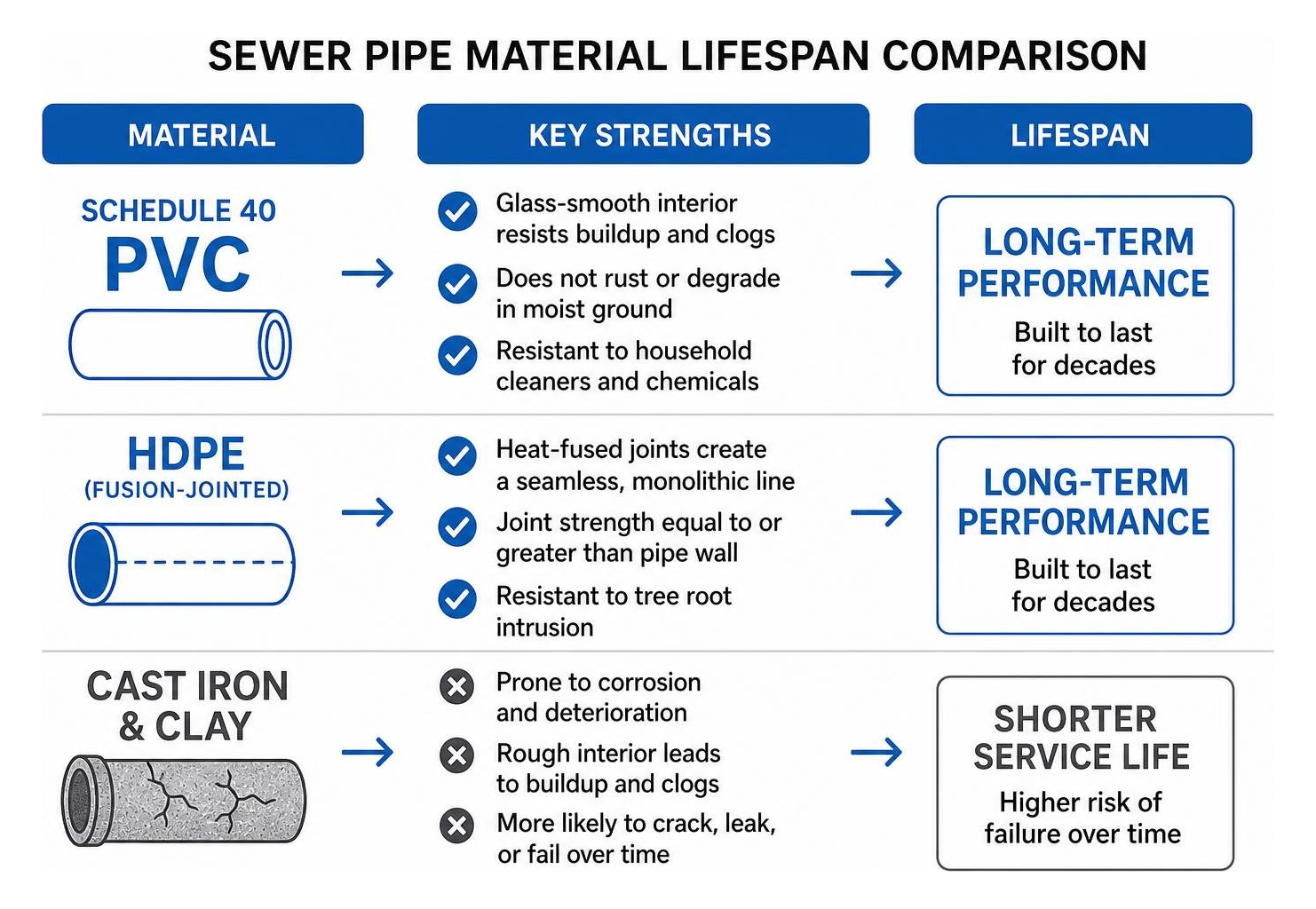
For main sewer laterals running from the house foundation to the municipal connection or septic tank, High-Density Polyethylene (HDPE) is an excellent choice. HDPE pipe sections are joined using heat fusion, creating a seamless, monolithic line with joint strength equal to or greater than the pipe wall itself. Because there are no mechanical seams, tree roots cannot penetrate the pipe. When planning a professional sewer replacement, transitioning to HDPE or Schedule 40 PVC provides a reliable system built to last for decades.
Trenchless Technologies vs Traditional Excavation
Replacing an underground pipe used to mean bringing in heavy backhoes, digging up driveways, tearing down landscaping, and leaving a deep trench across your property. While open excavation is still necessary in certain scenarios, modern trenchless technologies offer cleaner, non-invasive alternatives.
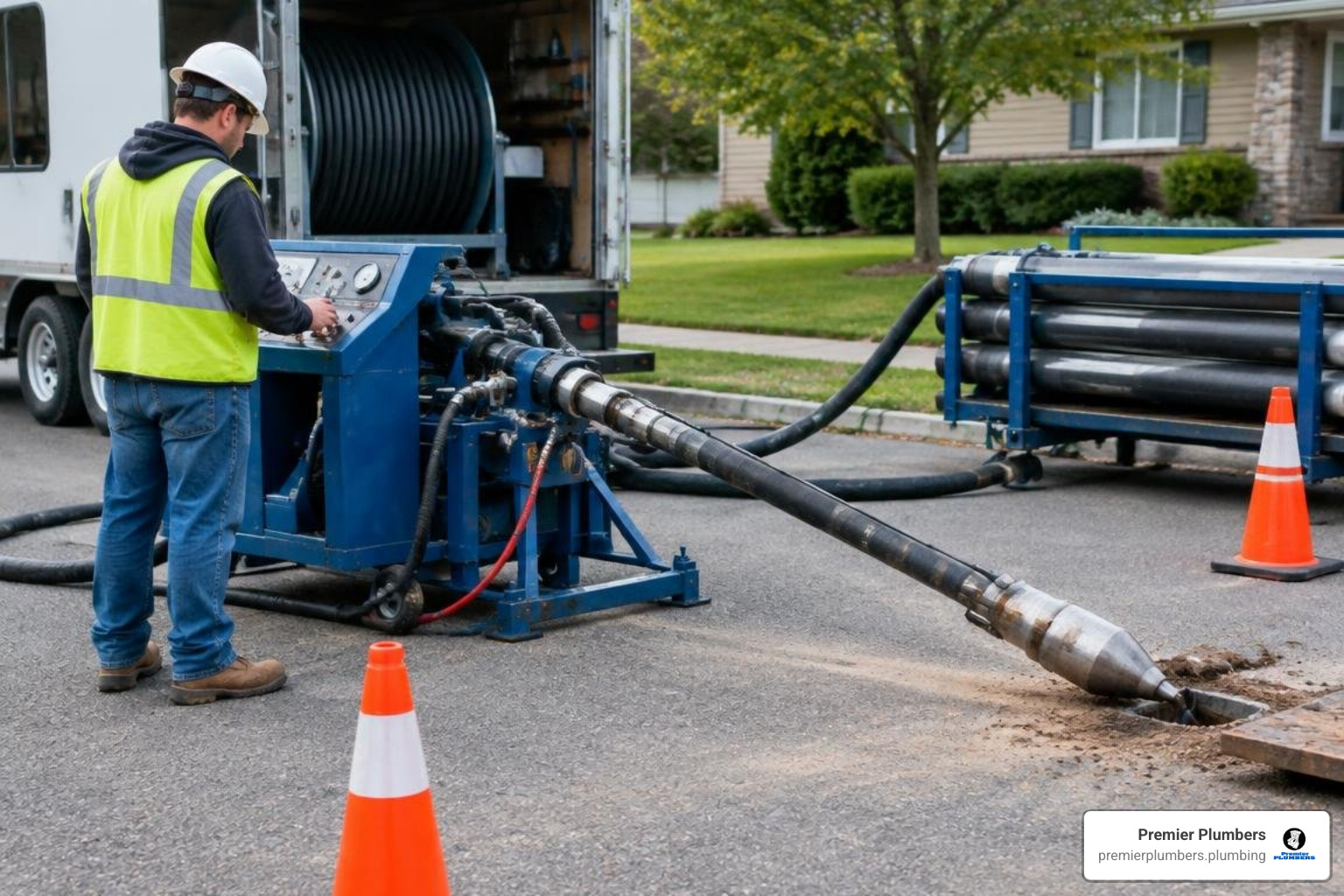
Non-Invasive Trenchless Pipe Replacement and Lining
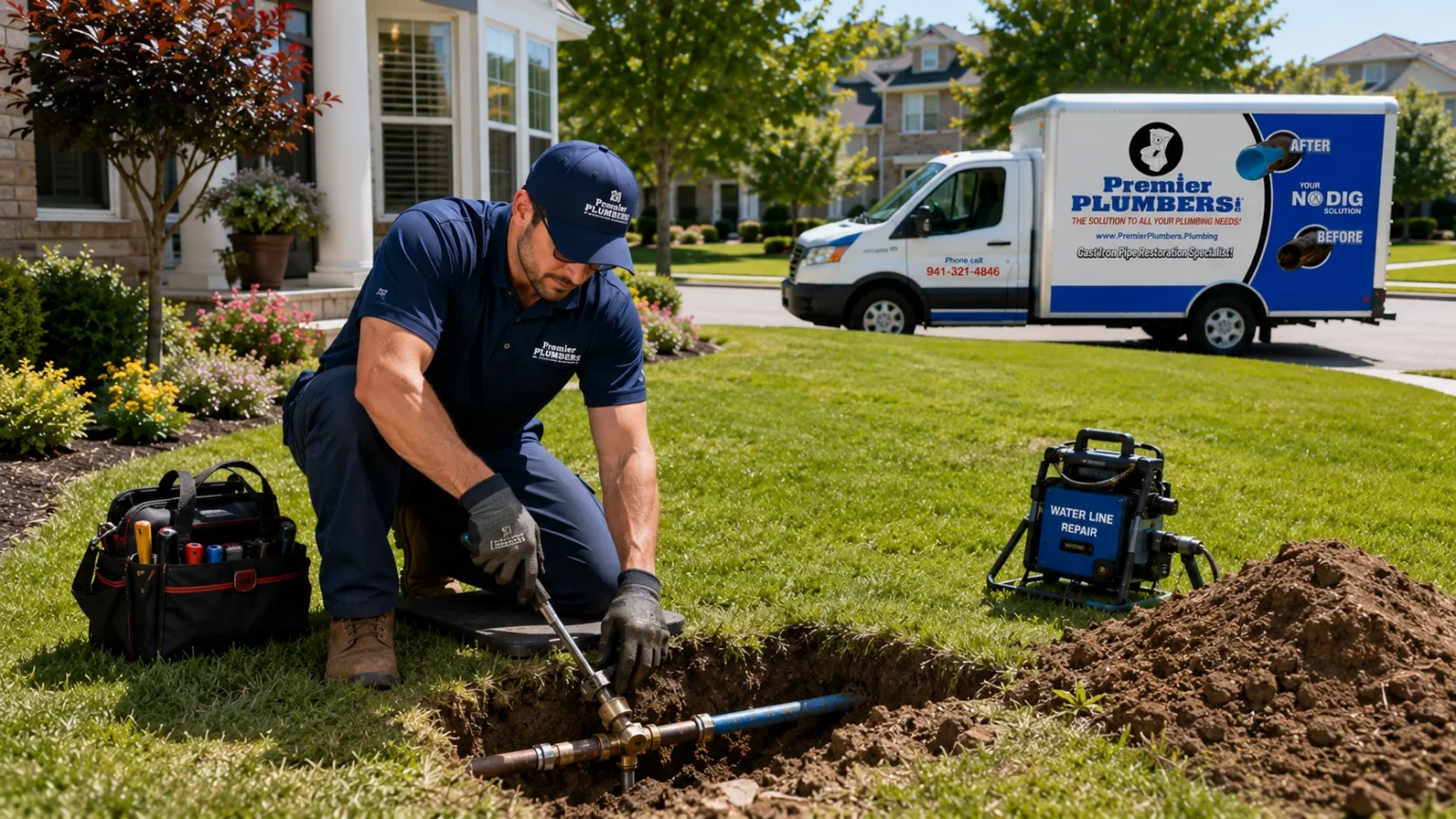
Trenchless methods allow our team at Premier Plumbers to restore or replace buried lines while leaving your yard, patio, and pavers intact. The two most common trenchless strategies are pipe bursting and cured-in-place pipe (CIPP) lining.
Pipe Bursting: This technique replaces a damaged underground line without digging a continuous trench. A powerful hydraulic winch pulls a hardened steel bursting head through the failing host pipe. As the conical head moves forward, it shatters the old, brittle pipe (such as cast iron, clay, or PVC) outward into the surrounding soil. At the same time, it pulls a brand-new, continuous run of seamless HDPE pipe into the exact same channel.
Pipe bursting requires only two small access pits, usually at the foundation disconnect and the utility connection. This approach can even upsize an undersized 3-inch drain line to a 4-inch line to improve flow capacity.
CIPP Pipe Lining: If the host pipe is structurally sound but has cracks, root intrusions, or worn spots, trenchless pipe lining solutions can create a pipe within a pipe. A flexible fabric liner saturated with epoxy resin is inserted into the pipe and inflated. Once the resin cures and hardens, it forms a jointless, smooth inner wall that seals leaks and locks out tree roots for decades.
Open-Trench Excavation for Severe Structural Failures
Trenchless technology is effective, but it is not a universal solution. Traditional open-trench excavation remains the proper choice when:
- The existing pipe has suffered a total structural collapse where pulling cables or liners cannot pass.
- The sewer pipe has significant “bellies” or sags caused by soil shifting, requiring re-grading to establish proper gravity flow.
- The line has severe offsets where broken sections have shifted out of alignment.
- The pipes are buried at shallow depths right next to other utilities where expanding broken pipe fragments could cause damage.
When open trenching is required, our crew works systematically: carefully cutting concrete, setting aside sod, digging the necessary trench, laying properly supported pipe on compacted bedding, and restoring the surface to its original state.
Planning Your Whole-Home Repipe: Process, Timeline, and Costs
Undertaking a whole-home repipe sounds intimidating, but when handled by experienced professionals, the process is clean, orderly, and minimally disruptive to your daily routine.
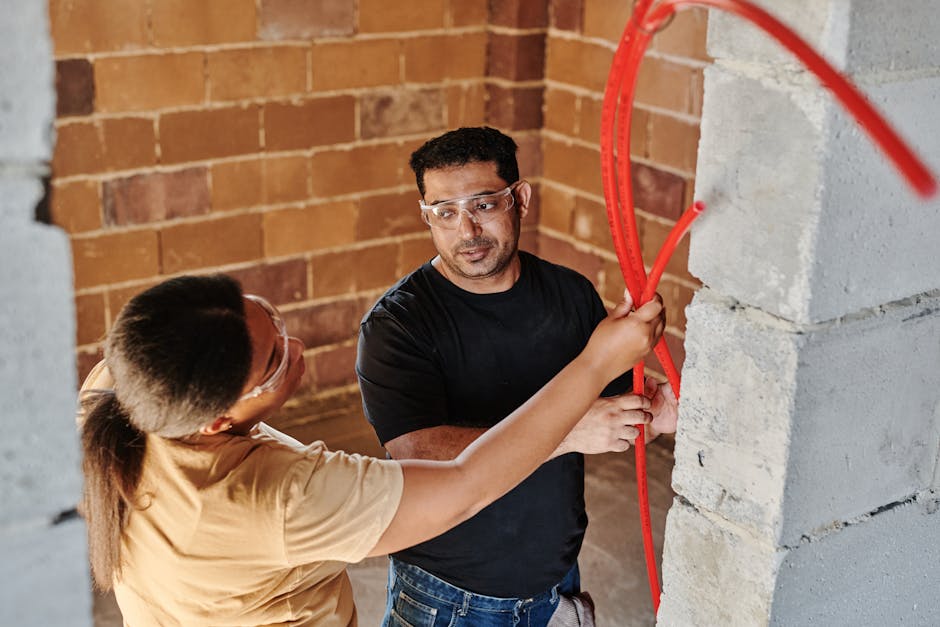
A whole-home repipe involves mapping out the most efficient routes through attics, crawlspaces, and wall cavities. Technicians cut small, surgical openings in the drywall near fixture supplies to feed flexible PEX piping.
During the installation phase, the existing plumbing system remains operational, meaning your water stays on while the new lines are put in place. Water is typically shut off for only a short window on the final day to disconnect the old lines and tie the new system into the main supply. After new shutoff valves and supply lines are connected, the system undergoes rigorous pressure testing before drywall patches are textured to match your walls.
Homeowners planning a complete supply-line upgrade can explore Premier Plumbers‘ whole-home repiping service to understand how a professionally coordinated project is scoped around the home’s layout and plumbing needs.
Cost Factors, Labor Rates, and Permitting Requirements
Every home has unique plumbing demands, and overall project costs reflect several variables:
- Size and Layout of the Home: Multi-story floor plans with bathrooms on separate wings require more linear footage and labor than a compact, single-story ranch.
- Fixture Count: Every sink, toilet, tub, hose bibb, and water-using appliance adds to the required rough-in labor and connection fittings.
- Accessibility: Homes with accessible attics allow faster pipe routing than homes with flat roofs or slab foundations where lines must be navigated through dense wall configurations.
- Material Choices: While PEX helps lower overall labor and material expenses, premium copper lines require higher material investments and open-flame assembly.
- Permits and Inspections: A compliant repipe requires municipal oversight. Reviewing your local building department guidelines, such as the Charlotte County residential plumbing permit guidelines, ensures all backflow prevention, structural penetrations, and pressure tests satisfy local building codes.
Assistance Programs and Cost-Saving Strategies
Managing a plumbing upgrade is easier when you take advantage of practical cost-saving approaches:
- Schedule Complete Replacements Together: Replacing water supply lines and drain systems during a single remodeling project saves money compared to staging multiple service calls over several years.
- Explore Municipal and Utility Rebates: In areas where aging service lines contain lead or high water waste occurs, check with local utilities for fee waivers, equity replacement programs, or low-interest modernization loans.
- Notify Your Homeowner’s Insurance: Upgrading an outdated plumbing system with modern materials like PEX or Schedule 40 PVC reduces flood risk. Many insurers offer premium discounts once you provide proof of a permitted, completed repipe.
- Choose Trenchless Solutions for Sewer Laterals: Avoiding backhoe excavation saves thousands of dollars in yard restoration, driveway repaving, and landscaping repairs.
Frequently Asked Questions About Home Repiping
How long does a whole-home repipe usually take?
For an average residential home, the repiping process typically takes between 1 and 3 days. The rough-in installation of new PEX lines happens on the first day or two while your water remains in service. The water supply is generally turned off for only a few hours during the final changeover. Drywall patching, texturing, and final municipal inspections usually follow shortly after.
Is trenchless pipe bursting cheaper than traditional excavation?
When looking strictly at plumbing labor, the cost of pipe bursting is comparable to traditional digging. However, when you factor in the total project expense, trenchless pipe bursting is often much more economical. Traditional excavation requires digging through lawns, paved driveways, walkways, and patios. Avoiding landscape restoration, asphalt paving, and concrete repairs makes trenchless replacement the faster, more cost-effective choice for most homeowners.
How do I know if my underground main line is broken?
Common signs of a broken underground main water or sewer line include unexplainable spikes in your monthly water bill, soggy or unusually green patches on your lawn, warm areas on concrete slab floors, low water pressure across all fixtures, and sewage backups in lower-level drains. A high-definition camera scope inspection can quickly pinpoint the exact location and severity of any subsurface break.
Conclusion
Your plumbing system is the hidden backbone of your home, working every day to deliver clean water and carry away waste. Continuing to patch an aging, corroded, or brittle plumbing system often leads to recurring leaks, expensive water damage, and ongoing stress. Upgrading to modern PEX, PVC, or trenchless HDPE lines provides reliable water pressure, clean drinking water, and true peace of mind.
At Premier Plumbers, our team brings a three-generation legacy of plumbing expertise to every project across Southwest Florida. We take the time to evaluate your property’s plumbing system, outline practical repair and replacement options, and deliver long-lasting, code-compliant craftsmanship. When you are ready to protect your home with durable, modern plumbing, contact our whole-home repiping specialists to schedule a comprehensive evaluation and clear project estimate.